How can we talk to (young) kids about politics?

With the current state of the world and the International Court of Justice hearings the past couple of days, I’ve been thinking a lot about the way I want to involve my kids in politics; given that my educational background lies in the subject. I’m writing this after my son asked what I was listening to and so, I shared, in as much detail with age appropriate resources as I could.

Political discussions with our kids is controversial issue between my husband and I, because though we agree we don’t want to shelter them entirely, we also know that our children, (especially oldest) is highly sensitive, and striking a balance is hard. He actively worries about death, and takes a lot to heart; so not oversharing or making things too gruesome is a priority.

So what can we do? I think about these things: Share about what’s going on or hide it? Is there a line where its’s too much? Where is the line? What happens if we cross it? How much is sharing political views and how much is imposing our views rather than entering into discussion?

Keep in mind, my oldest child is not yet 7, so a lengthy debate with sources and citations is probably a few years away; but does that mean I shy away from it entirely? No.

Instead, I’m choosing to talk politics in a way that works for our family.

This means, I’m sharing the ongoing bombardment of Palestine and elements of the history including Oct 7th, through play.

PLAY is the way our children process things, so to me, it makes sense that we should talk about politics through play.

We talk about bodily autonomy, we’ve spoken about birth-rights, we’ve spoken about the climate crisis, all through play before; this approach works well for us.

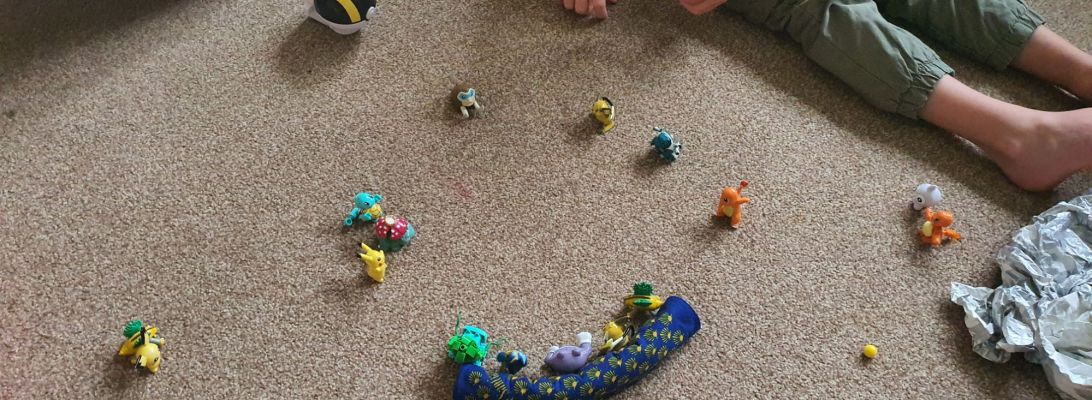
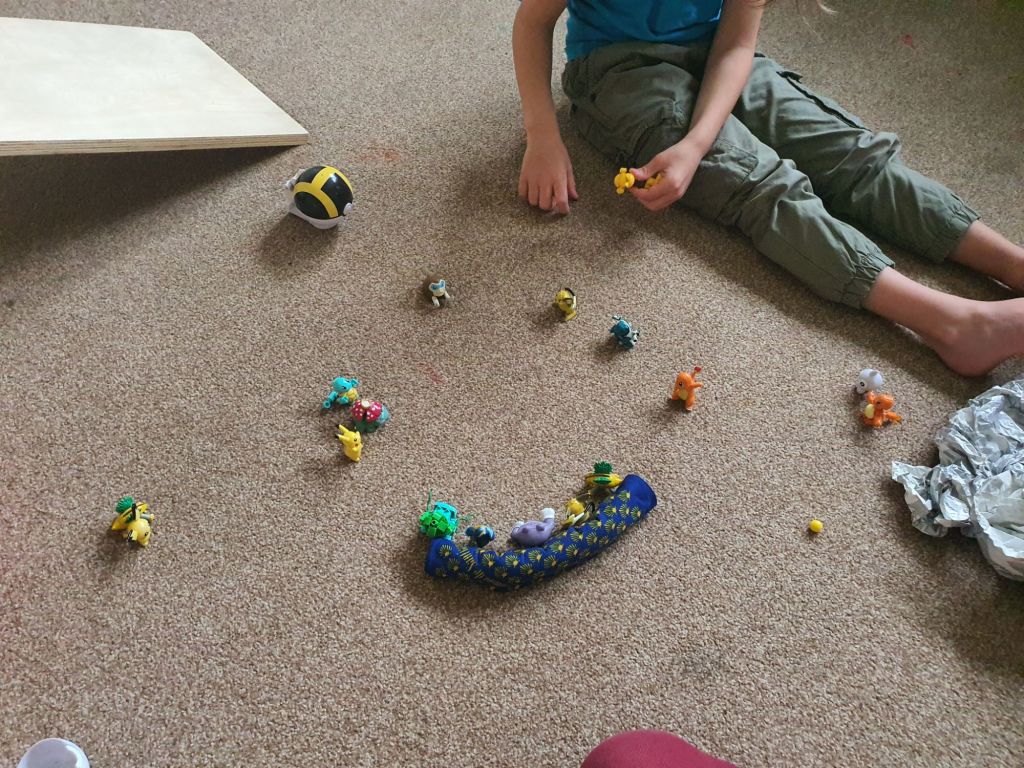
Today, as my son asked about the ICJ and what was going on (he couldn’t hear it due to my earphones), and we were just about to go back to playing Pokémon, I decided that the best way to explain it was using the Pokémon toys and creating a battle scene, where some were fighting, others were supporting and then there was a court of judges (also Pokémon) who were being asked to listen to and pass a judgement on the battle.

In using the toys, the intensity of what is going on was transferred to the toys; which made it accessible for my son, but also gave me the mental space I needed to play rather than assume we can talk about the dynamics of the situation. In doing this, time and time again I am shown that not only is play a brilliant method of communication, I am also able to hold space, work through questions – such as “why doesn’t Squirtle’s team do it like this?” or “why can’t all the Caterpie’s hide safely?” in a way that gives us so much scope for coming up with creative solutions and brings in elements of problem solving and conflict management that, in today’s play, gave my son the chance to work it out between the Pokémon, so that when they did all figure things out, the outcome worked best for everyone.

I understand this is utopian; but it works for us right now. As they get older, we may add in harsher elements that give more room for understanding the scopes of reality, but that is something that will come through play too, as they process, ask questions and develop responses where they understand that there isn’t always a clear winner or loser in life. We did this with Star Wards characters a few weeks ago, and my daughter, though younger found much more joy in the stories, branching off in her own spins to talk about how some win, some lose, and some have to say sorry, help fix buildings and some get lost in space – demonstrating that it isn’t always an age or stage, but the tolerance a child may have to cope with events of horror.

For my daughter, story telling and drawing is one of her chosen mediums of working things out. It is her play. For my son, it’s imaginary play, with characters we act out or toys we hold. Both are valid. Both have room to explore complex human emotions and situations. And importantly, both give me as the adult, room for impartiality, room to contradict, and room to support; in a way that a political debate with real life events probably would not do so graciously.

This is our set up today.

If you are debating talking to your kids about politics; in any scope, I implore you to consider this approach. If you are totally against it but not sure why, I’d say this allows you to be distant enough that it doesn’t have to resemble anything, but gives you a chance to test waters. If you are already speaking to your kids about politics, I’d love to hear how those discussions go (if you’d be up for sharing of course!).

With love,

Rohana x

Recommended Reads – 10 of my favourite parenting-ish books

I wanted to write something meaningful to start the calendar year. I’m still hibernating and retreating into my audible library, as well as actual real life books, so this feels like a fun way to share and be of benefit.

In no particular order, I’ll share some of my favourite books with either a birth-y or parenting theme. I’ve accumulated these over the last 7 years, so it’s not an exhaustive list, but if you’re looking for something good, I’ll say my standards are pretty high so those that make the cut will be thought provoking, note-taking worthy and sometimes triggering (in a growth kind of way).

I have read and listened to a variety of books, and some parenting ones don’t make the cut here because with this selection, I’d say you’ve got a fair balance of research based books, often that draw on others too, so I’m essentially trying to save you time – these are mostly easy to digest, mostly available as audiobooks, and all with information that will impact you as a parent (and human) in some way.

Oh and also, disclaimer, none of these are because I’m being asked to advertise them – I just had a moment of inspiration!

1. Raising Free People – Akilah S Richards

This book was one I didn’t know I needed to hear until I did, and now, since buying it in 2021 I have listened to it 4 times. It is like a hug. It is truth-telling, soul-warming and absolutely hard hitting in the spots where it needs to be. If you are going to read any book about raising humans, regardless of your schooling choices (because it is technically an unschooling book) this would be the one I would recommend. If you are considering a life without school, this book is, in my opinion, a must read! I was hooked from the very start.

2. Extraordinary Parenting – Eloise Rickman

Eloise is one of the most incredible educators I have come across in my home education journey. I found her by chance in 2020, just before the first UK lockdown. I have taken a few of her online courses and when she published this book, I pre-ordered it, knowing I would absolutely want to read every word. It did not disappoint. My copy has little post it tag notes, highlighted bits and dog eared pages throughout. It is an affirming read. It is radical and warm and about small revolutions rather than a big one, and it is through this book, and Eloise’s other writing that I first really understood the idea of advocacy for children, not just in my home, but globally.

3. Unconditional Parenting – Alfie Kohn

This book is a classic. I have included it here because it was my gateway into the world of peaceful parenting in 2018. It was through Alfie Kohn that I saw my son, not as a baby who I needed to look after, but really as a person beyond me. It was in these pages that for the first time, I didn’t feel guilty and overwhelmed, but hopeful; and though I still had so many lessons to learn, this book flung open the door for me to break away from mainstream parenting, in a way that I wasn’t confident enough to do so fully before.

4. The Birth Debrief – Illiyin Morrison

WOW. This book was immense. I listened to it over the course of a few weeks as part of a research project in late 2023, and it went above and beyond what I had hoped. What I didn’t expect however, was to find language and validation for my own births, because I thought I had pretty much processed everything there was to process – I had done a lot, but there was still enough for these words to feel triggering, soothing, comforting and then peaceful. For anyone who’s had a baby, or supported a birth, this book is a wonderful read.

5. It Didn’t Start With You – Mark Wolynn

The book was part of my 2020 lockdown book binge, because while parenting took up a lot of time, having both of us home, meant I got time to read and invest in myself. This is probably one of the hardest reads in this list, where there are triggering points, dull moments and overall a sense of ‘what is actually real then?’. It is also a book that I would recommend to pretty much anyone, parent or not, because it opens up the idea that we carry stories in our bodies from those who came before us. There are more recent books (I’m currently reading My Grandmothers Hands by Resmaa Menakem and this goes into similar themes), however, I would say that It Didn’t Start With You has a special spot in my own personal journey, and it feels more apt to have it here. The ideas in this book, epigenetics, trauma, ancestral lines, they are all themes that have stayed with me since reading it, and have informed many of the choices I’ve made to study, heal and break cycles where I can. Importantly, this book also gave me a sense of appreciation for the journeys of my ancestors, and though I wish I knew more about my family lines, it was through this book that I began to have the courage to ask.

6. Free To Learn – Peter Gray

One for the unschoolers here! This book was my first read into our education system and the way kids learn when we don’t interfere. It is still one I reference and I wish I had a physical copy because audible does only take you so far. That said, I know I wouldn’t have fallen in love with audiobooks without it, because this book was what catalyzed my decision to home educate. I was curious beforehand, but certain after listening to it; it showed me that I could give my children more than the school system could, and so far, it hasn’t been wrong. That said, while after reading it, I went through a period of being anti-school, I’m at a much more balanced space now where I can see the benefit it has for those it works for. This means, one of my children is in preschool, and my older child is firmly in the home-ed camp. If you’re struggling in the school system, it is a book I’d recommend, however, it absolutely won’t be for everyone.

7. Rise Sister Rise - Rebecca Campbell

Okay so this wasn’t really parent-y but it absolutely transformed my relationship with myself, and therefore also my children. Reading this book, doing the practices and seeing myself in a new light has catalysed my relationship with my children in a way that words don’t do justice to. It was in some ways the first book that made me consider how to be a good ancestor, as opposed to just being a descendant. In this, I also began to see that though we inherit trauma, we also inherit strength.

8. Playful Parenting – Lawrence J Cohen

I am slightly obsessed with the ideas of play therapy and this book brought a lot of them into accessible and ultimately realistic words which I could digest, contemplate and then implement. I read it in 2023, after I’d had it on my shelf for nearly 2 years, and I wish I had prioritised this one sooner. Probably one of my favourite books now, because although it was a little repetitive with examples, it also meant I got lots of potential viewpoints to consider and with my children each being at different stages, it gave me some really wonderful material to work through. It isn’t the most captivating read, and I had to put it down to mull over things at points, but for me that is a mark of a wonderful book.

9. Let them Eat Dirt – B. Brett Finlay & Marie-Claire Arrieta

I read this one in early 2020, and it was thrilling. I had been curious about much of the parenting practices where we give kids more autonomy and trust, but had fears over hygiene (to an extent) and so was worrying, especially after some illnesses and scary moments with my firstborn. This book highlighted why I felt uneasy about giving them medicine for the sake of it; why it was better to have a slightly ‘dirty’ house and child as opposed to hand-sanitizer at every corner, and why, when the option is available, a vaginal birth has many health benefits. What I particularly loved about this last point is that the book spoke directly to the fact that medical intervention is going to happen because in this day and age, not only can it save lives, but also create a sense of empowerment; and so rather than end with ‘vaginal birth is optimal’ it also gave suggestions about how, when birth is via cesarean, we can still provide our babies with the influx of good bacteria that they would get through the birth canal. As a newly trained doula back then, this was exactly what I needed to hear in order to support families through whatever choices worked for them.

10. There’s no such thing as bad weather – Linda Akeson McGurk

This is a book every parent should read. I’m guilty of hiding in ‘bad’ weather. I also try to a lot less since reading this. This book demonstrates how it isn’t the weather that is our problem, but rather the fact we aren’t prepared, or can’t be bothered, or in many cases, just don’t know how to brave a harsh day outside because it’s habitual to hide. I am someone who fully advocates for hibernating when needed, but equally, getting outside makes a world of difference for every single member of my family; this book gave me the confidence to find more balance, and to say f*ck it, suit and boot up and go get wet in puddles because it builds resilience and gifts our children the opportunity for joy all year round, not just when the sun shines.

The End

That’s my top 10. I could add a few more, but maybe I’ll do that another day. For now, if you read any, I’d love to hear what you think. If you’ve already read some and fancy a chat, let’s do it in the comments! And, if you have a book rec you think I’d enjoy, get in touch and let me know. I’m always looking for another good read to add to my giant pile!

For now, enjoy x

Rohana
Connection, Causal Comments and Costumes of our Life

I wrote this more than a year ago … for some reason, I thought it wasn’t right to share at the time. Perhaps because I felt raw from the day, or perhaps because I got busy … either way, I’m sharing it now. Because as I read it back, I realised just how much I needed my own words today… and I am so immensely grateful that I have this space to write.

With love, from a past version of myself xox

” I was on the bus today, and of course, bus trips mean lots of people. Always opinions, some lovely, others not; but more recently, as I’ve been building up to solo trips with the kids again in the better weather, with them all being older, and E, now 20 months having lots more opinions about the buggy; I’ve thought about how we use the time travelling to connect.

Today, we played I-spy, our version of the game, using colours instead of phonics, and sometimes throwing in the odd shape or physical reference like ‘tall’ or ‘wide’ instead. The kids sat, and looked around, and E started to whine because he was strapped into the buggy. Luckily, another mum got on, and the connection between him and her daughter began, until he fell asleep!

We (mums) chat for a while, talking about kids and coping; she shared some wisdoms about being a mum of 7, and I shared some frustrations about villageless parenting. We connected – over the shared experience of splitting ourselves into multiple pieces, stretching so our children could have parts of us, and simultaneously loving the chance and choice to do this, and being exhausted by it. I told her I thought her family must be beautiful, and I admired her honesty. She told me that it gets easier and harder, affirming that no choice is right, but that we do what we can with the knowledge we have.

A brief, meaningful chat, interrupted by a gentleman getting on the bus and sitting down adjacent to my older 2. “you’ve got your hands full” he said gruffly to me.

“Oh I really do” I replied. “Full of love with my amazing children”.

“Uh, not all the time I bet” was his response!

The other mum looked at me and we shared a moment of horror at the roughness in his voice.

“They really are amazing” I told him. It was our stop. We left.

And once again, I thought about connections. Some positive, some negative, all, inevitably will have an impact on our energy fields. Why do some people feel so harshly about children? Why do they judge when there is more than 1? What did he gain? What was so triggering for him? I wondered aloud a little, with the general cautionary calls to my kids about the road. I thought about how hard it might be for some people to see kids being so free and confident, when they might have never been given the chance to be so.

I wondered how my children felt. Though they know we’ve had these comments and conversations before, so they said they were hardly ruffled, more interested in the scrap metal yard instead. But how does this impact children? How do we make them feel when we comment about how hard they are constantly?

What message do we send when we say, I’ve had enough of you? Because in most instances they never get to say that to us.

Thinking about my children, and the brief beautiful encounter with this lady, I remembered a quote I’d read in an email this week by Rupaul that “You’re born naked and the rest is drag”.

Kindness costs nothing.

The appearances we choose every day impact every single human around us. We are born naked, and needing others to survive… as we grow we create costumes for ourselves every season of life… and yet, when we die, we return to the earth .. dust. The short space of time in between, in the costumes we choose may be brief, but it is so powerful.

The lady on the bus today gave me hope… and it was thanks to her, that though the gentleman’s words stung, I could brush them away, and hold my babies close. A year ago, I might have been brought to tears (probably would have!). Thank you, whoever you are. I am grateful.”

That’s it.

That’s the post. A short meeting that left a big impact.

Whatever your day looks like. Wherever you are in the world. I hope you know this:

You are loved. You are important. You are so much more than enough.

Self study, dopamine and why I’m not worrying that my kid can’t read yet.

I’m currently taking a Chinese medicine course, all about Traditional Chinese Medicine in relation to women’s health.

When I read about it before buying, it sounded fascinating.

Now, taking it, I’m really struggling to understand anything, and as a result, I’m putting off the study. There’s so no dopamine hit at completing units because I think I’ve understood it, and then realise I’m still very confused.

I’m learning about myself as I go though, because nobody is making me do the course. I could quit. Nobody would hold me accountable, and yet, I’m continuing – at snails pace – knowing that if I keep at it, by the end, things should fall into place and I’ll understand.

I’ve got pieces of the puzzle, but not the big picture yet.

As I watch this unfold in my own life, I’m also reflecting on our home education styles and where my children are at. P is 6 and he isn’t reading or writing yet, he can recognise letters, and even some words, though will often choose to say he doesnt know. A is 3 and showing a bit more interest in writing letters, though only on her terms. If corrected, she gets upset.

They are both at different stages, both with different pieces of the puzzle.

P doesn’t get a dopamine hit from reading or writing in the same way he does from science experiments or inventing. A gets more joy from writing, but she also gets frustrated quickly. She loves making up pictures and will come tell me about them, and the delight in her sharing is something I am determined to preserve. To me, it isn’t worth pushing anything more that that, because I trust that it will all come in time.

If they were schooled, in this country (UK) generally, most kids are expected to have at least started on the writing and reading path by the age of 6 (earlier for many). If not, they’re the B word – behind! The pressure put on young children to write and read is immense, and I’m not immune to seeing others children and worrying about if I should push mine more. That said, even when I do worry, I come back to a place of trust, unpicking my own feelings of being ‘behind’ or not performing well enough when I was in school. This is the beauty of our choice to unschool – a label I’ve become more and more comfortable with adopting recently.

As I reflect on my course and study, I know that as an adult, I understand the long game and benefits of continuing even when it feels hard. The ability to delay gratification is a skill I work on, and in this case am leaning into. I can see that eventually the pieces will come together; and I’m giving myself permission to take it slow but also not give up.

As I watch my kids, especially P, I see this kind of grit and motivation when they do things that come from a place of pure love. When they build or draw or tell a story, or even climb a tree; and they fall or it goes wrong but they get back to trying, slower, learning, more cautious yet determined.

It is something so easily missed if not looking, but once you see it, the intrinsic motivation in our children is a beautiful expression of their humanity. The drive to accomplished something, not for a sticker or praise, but for the genuine love of it – it’s in all of us, stamped out by instant gratification systems and manipulative rewards.

I am learning to slow down more, lean in to the long game.

They don’t need to learn it; they already know it, innately.

When P turns to me and says, I want to read, I’ll be ready. When A asks, it’ll be the same. Maybe I’ll get the bonus joy of them wanting to do it together, a joint learning adventure.

Until then, I’m not worrying too much. I’ll learn for my own joy, and we’ll listen to audiobooks and read stories from the bookshelves. We’ll play and dance and take the pressure off… and maybe by the time I finish this course, I’ll be better equipped with new resources anyway.

As ever, thanks for reading.

With love, and a reminder that nomatter what, you are enough,

Rohana x

As they grow and develop their skills and understanding, more puzzle pieces fit into place. They’ll start to find more joy and less frustration and they’ll choose to both read and write for fun in their own time.

Radiators, Drains and Energy transfer

A while ago a friend of mine was chatting about energy vampires, and how the term really wasn’t fair because often people don’t mean to suck the energy out of others. Instead she said, she was taught about how people can either be radiators or drains.

We can radiate joy or love, or we can pull the plug, and it’ll drain out of us, and eventually other people to.

This really resonated with me, because I think many of us go through periods of being both of these throughout our lives, and sometimes, we’re neutral – though always a little more inclined to one pole. That said, life in 2023 is anything but binary, so of course, thinking about our energy contribution or contamination is the same; we all sit somewhere in the spectrum.

Where we sit is up to us. At least in part.

Yes Tony Robins will tell you that you decide it all, that you have a giant within and can bend space to your will; and I believe him to an extent, but I am also a neurodivergent woman who’s got 3 (also likely neurodivergent) kids and a 12 week old puppy. I know, that as much as I can decide something and make a plan, life happens. What I can do is figure out who the biggest energy in the room is.

Confused? Yeah, I was too!

It’s taken me a while to figure out what I meant when I wrote that down in a journal after listening to many talks and coaches and trying to figure out why I was still spending days spinning out when my kids and life got chaotic.

I can control what I do / how I react within the capacity I have.
I can check in with my body and see where the energy is.
I can look to find the biggest energy in the room – i.e. who’s the radiator or who’s the drain, and who’s winning?

If I’m with my kids and my 6yo is bringing all the radiator energy and LOVE for whatever the game is, I will absolutely give him the space to be the biggest energy.

Conversely, if he’s in a grump or screaming; I need to be a bigger energy so that I can help him through co-regulation. Fancy word, but all it means is I can step in to help calm without joining the chaos. Importantly, I need to genuinely validate the chaos first.

Then, I set the mood by leading.

I choose to drain the grumpiness away and instead radiate a more neutral feeling.

Does it always work? Nope.
Is it effective? YES!

Like everything, sometimes things change, sometimes I’ll try switching to fun and they’re hungry or too hot and the attempt at fun actually peaks a whole new drama. Sometimes, I just haven’t got the energy.

But regardless, as my son said to me recently “we’re all just made up of energy and molecules moving around” so no-matter what we’re doing, we are somewhere on that spectrum.

“we’re all just made up of energy and molecules moving around”

P, aged 6

I’ll leave you with these musings for now,

As always, thanks for reading. You are awesome!

It takes time to change

“You doing okay?” my partner asked today.

“I feel like a shitty mum and a shitty wife for dumping loads on you today” I replied.

“That’s what we do things, if you need help, ask”.

He just gets it.

So for context, the day has been SO good and also SO rollercoaster-y; like many many of the days in my life with the kids and now our puppy. We’ve had her for nearly 4 weeks, and it’s been the hardest time in many ways, and not because of toilet accidents or night waking.

I’ve had rebellion in the rain over shoes and socks at the park, and tears over wet bums and cold feet. Stomps because dinner wasn’t right and so many sibling arguments to referee today. It’s a beautiful chaos, topped into explosive territory because my middle and youngest child have started squeaking like squeaky toys around the puppy, and freaking out when she comes to play and jumps on them. So I’ve been separating the crazies all day.

Pretty normal.

Also a lot.

Which led to this text conversation… and me sharing my feelings.

And then, true to pretty much everything in life, especially with P, he couldn’t sleep. So started to chat about molecules with me; and we went downstairs to tidy up and set up an experiment.

3 bowls – water, ice and air.

He sat on the side; and watched, telling me the water would evaporate and ice would melt.

It takes time for things to change mummy

Another day, I might have nodded along and agreed without much thought, but tonight, he brought a much deeper lesson. He was talking about the molecules in the ice cube; I was hearing words that resonate about life.

It takes time for things to change.

And honestly, we live in a world that prioritizes instant gratification so much that waiting feels especially hard. We want things now, we want things tomorrow, we want things yesterday.

I think we’ve forgotten the beauty in the build up of excitement while we wait for things.

Its not easy, in fact, waiting is downright uncomfortable, and probably why I’ve been in such a weird headspace today; but waiting is a part of life, and the fact that he gets that; the fact that it’s just normal (ish) for him, makes me feel really hopeful tonight.

Wherever you are reading this,

Whatever life is bringing you,

Whatever changes you are waiting for,

It takes time.

So I’m here waiting with you, and want to remind you, you are loved, you are important, you are enough.

Thanks for reading,

xx Rohana

The Ripple of a Supported Postpartum Period.

The experience of welcoming a new human earthside is a remarkable journey. I’ve done it 3 times… and the feeling I get when I share my experiences, and listen to others is incredible. There is something so sacred about birth.

However, though absolutely deserving of the attention it gets; birth is the highlight in media and many conversations; with postpartum being a little left on the wayside. For first time parents, there is some emphasis placed on the changes of this transitional period (though by no means enough); but after that, it kind of just dissapears into the noise of everything.

Postpartum is just as – if not more – sacred that birth.

As I prepare to deliver a session next month on the postpartum period to some wonderful Doulas in training, I am called to write about it here too.
In part, this is because, through the whole rollercoaster of parenthood, the attention, support and social associations between male and female parents is so different. I honestly cannot speak from stories of same sex couples; because to date I only know 2 same sex parent families who’ve had children, both of whom are female identifying. That said, we’ve all seen the memes where mum goes to the shops and is expected to ‘control the toddler’ versus dad who is ‘so wonderful’ for literally being a parent.

Nonetheless, outside of social expectations, speaking to men about their experiences postpartum – it is just as lonely, if not more so for them. It is isolating. It is hard. They receive even less support, with many (much needed) services aiming to support mothers as they transition into motherhood, and few doing the same for fathers.

Yet, it is, in my opinion, vital to recognise, support and celebrate the role that fathers play in the postpartum period.
Supporting families as a whole unit here, in these early months, can lay the foundations for a family life that is built on a strong sense of connection, trust and nurturing. Not only is the child or children in a far more stable, healthy environment for their emotional growth, but both parents are more likely to communicate kindly with each other, have compassion, and connect in a more intimate way – which, let’s be honest, isn’t going to harm anyone’s sex life.

How can we support families as a whole unit?

In my postpartum prep session I dive deeply into conversations about the 4th Trimester and ways we can really support families.

If I could gift any new parent something, it would be this support. A step towards that is this information.

Nourishing the Body with Good Food:

One of the most fundamental ways to provide support is by ensuring that postpartum families are nourished with good food. In the absence of being able to literally take someone food (because honestly thats a BIG task), recommending recipies or supporting them to create a meal train where friends/famkly bring food, can make a huge impact.

The demands of parenting, combined with sleep deprivation and physical recovery from labour and birth, will massively affect new parent’s energy levels. Fathers, in particular, often are expected to step up to ensure that the family is well-fed during this vital period – and a sense of support and direction is helpful.

Nutrient-rich meals not only aid in physical recovery but will contribute to state of mind. When both parents are nourished with wholesome, healthy foods, they are less likely to falter in moments of stress, because they are physically having this need met.

Rest

In a fast-paced world, the idea of rest that isn’t justified by some kind of productivity beforehand might seem elusive. However, the fourth trimester calls for a major shift in perspective, where rest is acknowledged as a precious commodity. This is as true for fathers, who at least in this country are required to go back to their day jobs only 2 weeks after baby arrives, while still adjusting to their role as supporting the family in this new way.

Many conversations centre how fathers can take on more responsibilities. In part, yes I agree, because nursing a baby is a full time job and mums need rest. But, radically, I also assert that fathers should prioritise rest.

This should absolutely be a conversation before baby arrives. Dishes can be minimalised. Hoovering doesn’t have to be as often as it was. The house will be a mess and that’s okay. When dad’s rest is prioritised alongside mum’s, there is more balance, more opportunities for meaningful conversation and more joy.

Mental health

The last big focus in creating a supported postpartum experience, without diving into the other (essential) aspects mental health.

Yeah that’s too vague Rohana … we all know mental health matters, but how do we do anything about it?

  • Chat openly and honestly. Before having baby and after. Every step of the way… honest, non-judgemental conversations are essential. This is probably best done when everyone has been fed, and there isn’t insane levels of sleep deprivation being used as competitive advantage in the who feels worse game. But seriously, taking to partners about the JOYS and the things that are hard, makes a difference.
  • Divide and Conquer. Divide jobs/tasks. Remove everything that isn’t essential to be done by you/your partner. Delegates the none essentials. Easier said than done… I’m banking on the idea that you’ve got a gorgeous groups of family and friends who want to help (and can) OR a wonderful doula. If neither applies (it didn’t for me!), then lower the bar massively. Do the essentials. Survive. This isn’t forever.
  • Find friends. Groups. Peanut. Facebook local groups. Whatever is an option… if you can, use it. Parenting is isolating, and by having someone to give and receive some solidarity around, it helps. *careful not to just find ranting buddies who keep you feeling low*
  • Lastly, do things for joy. Don’t give up hobbies. Don’t ask your partner to. In fact, schedule them in with extra vigilance, because being reminded that you’re a human outside of helping this tiny person grow and survive is really important.

There’s so much more to say… creating a supported, wholesome postpartum and beyond experience isn’t going to magically happen. It is worth the work though, because when you are supported, you feel safe.

When you feel safe, your nervous system capacity can hold more.

When you feel safe, baby (and other children) feel safe too. Their mirror neurons mimic your regulated state.

Then, the cycle of safety, support, joy repeats. It cycles. And grows.

This time for growth and unity as a famkly builds the sturdy foundations of trust and connection, which, when toddler and teenage years come by, will be something that holds everyone through.


As ever, thank you for reading.

Rohana

Grief: The Death of our Dog

Talking to kids about grief is a big topic, and it’s often one that many parents find hard. Most adults steer conversations away from grief, or are awkward when it comes up. So talking to children is even harder.

And it’s even more important.

These are my reflections of our experience of losing my parents dog, how it’s impacted my children and how it’s opened windows into conversations that we’d have otherwise probably not have had.

Last year, we spent a few months in Gibraltar living with my parents, and consequently my childhood dog who was 17 years old by that point. Soon after we came back to the UK, my dog (Lucky) died.

I didn’t bat an eyelid. Mum messaged me, and within the same hour I told my kids.

In my view, an hour, or day or week wouldn’t make a difference, except that I’d be lying by omission with absolutely no reason to. I knew it would be sad and hard, and I also knew that they would need the time to process it; so by telling them straight away, I could have my feelings and then be able to hold space for theirs when they came through in full force.

This proved to be an extremely valuable decision for us, because by the time the big feelings came a week later; I’d been able to light a candle, say a prayer, and celebrate the life and joy my dog had brought. It gave me the mental space to hold them, hear them, and also steer them through their grief. Yes she was a dog, not a person, but she was family, and they felt the impact of her loss deeply.

We had read books on death before, and regularly spoken about the circle of life, and we’d told the kids that Lucky was old in her bones. She slept a lot. Was slow. We knew it was coming.

They loved her. In the short spurts of time they’d spent with her, she left her pawprint in their hearts; especially my oldest who met her for the first time when he was 5 days old. She’s a part of their story, and their first real experience of death and grief.

When it hit them, the kids cried. They asked what would happen. They asked where she’d go. We spoke about different traditions, and how she specifically had been cremated so her ashes would return to the earth and new life would bloom where she was laid. Our favourite book was The Endless Story which is illustrated beautifully.

My parents kept her ashes and when we went back to Gibraltar, we scattered them together. We spoken about the grass and flowers, and how the ashes would seep into the soil, and be a part of the process to create new life. We spoke about how some people (including me) believe in reincarnation.

There were many tears. There was a lot of very audible and visual grief… and I told the kids to let it all out. They could be as sad as they wanted, in whatever way felt right to them.

My daughter collected flowers and cried. My oldest son sobbed and shouted, and said he wished we could be immortal jellyfish so we’d never die. My younger son wasn’t sure… he was too little really. But he was there, and that mattered. My parents and brother were with us of course, and they held my children, shared some fun stories and shared in sorrow too. It was a hard and important day.

That was 6 months ago.

With his recent birthday, P woke up several times in the weeks leading to it, with sobs of not wanting to get old because getting old means we are closer to dying.

Since then, topics of saddness, missing loved ones, wishing nobody would die, worrying that we’ll all get old and die, wanting to be cremated together and various other aspects of death have since become a part of our life. At any given moment, sometimes close together, sometimes with weeks in between, they’ll make a comment, or get quiet, or have a wave of tears about Lucky being dead. A (aged 3) has commented and cried things like “I didn’t want Lucky to die” or “I wish I could stroke Lucky again” … but her process has been straightforward for me, we’ve cuddled, cried, sonerimes shell ask for a story of when Lucky was little or for me to tell her about when she’d help my dad with dog walks, and then that’s it. P (aged 6) on thr other hand, has not been so straightforward; like with pretty nuch everything, his high sensitivity has really shone through.

The way I’ve been managing this has varied; sometimes it’s just a case of listening, reflecting back what he’s said, and then holding him through it. Reminding him that I am here and these feelings are normal. He often will spend a few minutes here in this space and then enter a new conversation with me or say he’s ready to play.

On his birthday, he said when we die, we disappear forever, and so I brought in the concept of memory keeping us alive, and about how people leave their legacy; I specifically said about how people that invent things might live on through their inventions or discoveries, like gravity and electricity, or through movies and stories like Vikings, or through preservation like the dinosaurs. All of those creatures/people might be dead, but we haven’t forgotten them. This worked remarkably well, and he visibly relaxed as he worked out that we fly planes and take pictures and drive cars, even if the people who invented them lived long ago.

Lastly, if it’s a really hard one, or a particularly big feeling, like when P says he wants us to all be immortal jellyfish, or when he tells me that he’s scared he won’t come back and be with the same family, I remind him he can choose what to believe. They there’s no right or wrong, and that nomatter what, we are here now, making the best of it. Usually this also involves cuddles or closeness too, something I’m particularly aware of because I want him to feel safe through the feelings.

Chatting about the grief has open windows of conversation, and we’ve spoken openly about how grown ups come back and that also not always. We’ve spoken about safety first in situations like climbing or jumping or in the car. We’ve spoken about age, and how age isn’t the only factor in death.

Mostly the emphasis is on saying thank you to the earth; for growing more and blooming, and showing us that there really is a circle of life.

As ever,

Thanks for reading xx

Rohana

Little voices, Anger and our brilliant brains

You know when they’re little, they say some things but it sounds a little funny because they can’t quite pronounce it yet. Then suddenly, that little difference stops, and we wonder when they learnt to say words the way we do. Every time I hear my littlest talk at the moment, I want to record it all because I want to bottle it up and preserve the sweet accents and voices he does. Of course, that defeats the purpose of being in the moment and actually listening, but I have snuck in a few videos to send family and save as reminders.

I know that these years are fleeting, even when they feel busy. As we approach birthdays, where K will be 2 and P will be 6, I am reflecting on the way they have changed and the language they use. I don’t even remember when it became possible to have such grown up conversations with P, but he’s chatting away nine to the dozen daily, always with a new idea, explanation or request to build something in play. Today we’ve been playing Archelon nests and Ovoraptor mums and I’m struck by how this has become such a norm for us.

P delights in telling me everything about anything; and some of the most interesting conversations happen while he’s chatting away after bedtime, or when we’re out and I can lend him an ear a little more readily as we walk along. He doesn’t get words in as often as he’d like because I’m pulled between all 3 kids, and I can see that it’s having an impact; so when we’re out and he tells me about life and stories, I savour as much of it as I can.

A on the other hand, doesn’t wait for opportunity, she will talk and talk and talk, and has been for years. She really enjoys watching videos on my phone that I’ve taken of them over the years, and sometimes will tell me there’s a specific one I need to see. It gives me the chance to relive some of the best moments, and reminds me why I capture so much when I can; because they change and it feels like forever but also too soon. Hearing her talk on these videos brings to light just how early she’s articulated and narrated her life; and I do sometimes joke that we must have blanked out some months during the pandemic lockdowns because she feels far more grown up.

That said, though I watch my children and marvel at the way they act for their years, I also know they are very much this way because they’ve been given the freedom to grow their voices, challenge us, and come back to safety. I didn’t start parenting thinking this would be the way we parent our kids, but as the years go by, I am more convinced that it’s working well for us. A mix of ideas, lots of trying things out and lots of changes to empower the humans we’re growing with.

A couple days ago, I asked P to stop swinging and hitting the wall with his feet. A little while later, he got upset with his sister and went to throw a punch. We sat down, he screamed at me and told me he had to go hurt her because she started it. So I said “I get it, you’re so mad right now, your hands won’t even let you stop being angry” and then I showed him how when we clench our fits ready to punch, our body and brain message each other to be angry. Alternatively, when we hold our palms flat, open towards the sky/ceiling, our body and brain send messages of calm.

Fascinated, but still upset with his sister; we turned it into a game where he would do something he knew wasn’t allowed – in this case hit the wall as he swung, and I would be “super, extra anrgy mummy” making a fist, stomping my feet and growling before chasing him until he turned around and opened my palms up to the sky and I’d sigh and relax.

We soon had A involved too and they giggled and giggled at the game; which from my reading about playful parenting, I absolutely took as a good sign on emotional release.

I not only marveled later about this snippet of our day from an emotional regulation perspective, but also through the lens of their little voices. I don’t have the urge to video record everything anymore with P, because he’s chats are so different, but I will bring out the dictaphone we bought to record stories with him; and a while back when he was interested and asked me to, we recorded some stories on a podcast for them to listen to. It’s hardly used, and there are about 4 or 5 I haven’t got round to uploaded yet because the interest was lost; but if they want to pick it up, we can. I loved recording them with him, especially where he’d say the words too, because it really felt like a moment of his voice frozen in a beautiful way. I’ve also used it to record stories for our Yoto player, and that’s been fantastic because they absolutely love listening to library books we’ve borrowed and returned, but preserved for when they are in the mood.

Speaking of our Yoto player, P gave me a quick lesson about how our lungs have trees called alveoli and about how the skin is actually our largest organ. He loves lying down with the player and going through the cards when I am busy with his siblings.

His sister on the other hand isn’t fully into audiobooks, but I have often walked into her reading to herself or chatting away about something in a book, to whom I presume are imaginary friends around her. Her chats are so different to his, and while he tells me how things work, she tells me how beautiful life is. She’ll tell me she loves things, the colours, the shapes, the sounds. She’ll ask to play games with me and then get bored, go find P and I hear them playing a version of things they’ve watched on TV, chatting away and planning roles. It’s the best sound, and one, I really never imagined we’d get to when they would fight all the time.

Home educating them has meant we focus a lot on conflict resolution though, and I can see my attempts and explaining energy and actions are starting to show. I can see how, even though I’ll have to call out “sort it out guys” or step in like with the punching scenario above; they are also learning how to work together. They call themselves a team, and P will say our team has 5 people, but because daddy’s away, it’s got 4 right now until he’s back. It’s a wonderful thing to hear for me, because even though I know it’s his coping mechanism and sounds a little sad, it’s also a beautiful one, and healthier than others from the past. I can see the growth, and importantly, I am learning more deeply that while I have influence over my children as their parent, I cannot control the way they react to situations but I absolutely can do my own inner work and co-regulate with them to build resilience as they get older.

This month has been a rollercoaster, in the same way that many months have been, with changes of direction and disconnection while we each find out feet figuring out what we need. I’m leaning into screen time as a tool for productivity but also for connection; joining them in their joy while they show me what they can do on a game, or chatting with them about the episodes they watch. I’m adapting so that they can have moments of time with me, which had been few and far between since their dad left in April, and I am factoring in, for the first time in years a 20 minute yoga practice that even if it’s midnight, I will make time for.

I tell my kids about their playdough brain; reminding them they can grow their brain and expand their capacity regularly. In doing this, I guess I’ve also been giving myself room to expand my own capacity too; slowly integrating the future I want to manifest for them from a cognitive ideal, to an experience. I have spent years focusing on making sure they know about their brilliant brains, and in doing so, I’m seeing this month how my own brain is brilliant too (and as a reminder to you reading this, yours is brilliant as well).

Wishing you a beautiful day, week and month ahead.

With love,

Rohana x