
Hard Seasons of Parenting

Ti’s the season… to be really honest about the phases of parenting that can look really dark and despairing sometimes, especially for neruospicy folk. It might be the new year and all that in the Gregorian calendar, but here in the northern hemisphere, the earth is still deep in her slumber, the days are dark, and as mammals, we should be curled up in the warmth in community, not isolated and out in the cold at all hours of the day.

The last few weeks of festivities and house move have been a real rollercoaster for me parenting wise, and now, I’m taking the time to record and reflect on them. I had been having a really tough time with K, with major meltdowns night terrors multiple time a week. Night terrors are especially scary because at least in my experience, my child isn’t really there at all, they look like themselves but actually have no resemblance to the sweet or fun personality of the kid I know. I’m grateful he’s my 3rd child, because I am aware this happened with both my older children and that this stage doesn’t last forever. That said, when you’re in it, in that moment, it feels like forever, especially when 20 minutes can cause so much damage. The screaming and rage is scary and hard, trying to keep them safe, from each other and themselves, trying to hold on to the knowledge that this is their primal brain, and that they are not consciously or willingly trying to hurt you … but then comes the after, and the pain I feel when the little sobs haven’t quietened yet and I’m stroking their face wondering what I can do to help. It is one of the hardest, darkest parts of parenting I have ever faced. It is one of the loneliest too, because who talks about how their kids tore the room apart or screamed that they wanted to destroy everything in the depths of feelings… nobody I know does.

I do sometimes to be fair, and when I have done so, the looks of horror or surprise, or then relief (depending on who I’m talking to) are always so visible. It’s hard though, and when people don’t understand, it’s easier to make small talk.

I’m really fucking bad at small talk though.

So I share … and recently I share more. The hardest bits, like when A told me she didn’t want to exist anymore because she was so sad in the middle of the night. Or when we played a game at the park, she didn’t fully understand it and thought she’d lost, and screamed and scratched for 45 minutes once we’d made it home, telling me we should have never started that game and she wanted to cut her jacket to pieces. I looked at her and saw that in this game and her reaction, she had created the perfect storm to play out her feelings of not getting what she wanted. She was bubbling over and trying to process her lack of control, and because children speak and heal through play, this was her doing the work of healing.

Thankfully, we have the resources to see that, to resource them, and to repair when ruptures are made. That night, as she sobbed in bed, and said she didn’t know why she’d found it so hard, I held her and said seriously “there is literally nothing you could ever do to make us stop loving you. You cannot hurt us, and we will keep everyone safe as much as we can, but your feelings are always allowed.”

I read the other day about how resources for emotional regulation and tools for a safe nervous system are a form of generational wealth and honestly I love that. These are tools that yes feel foreign to me at times, but are going to be (hopefully) passed down for generations to benefit from. Teaching them and learning with them is healing, for all of us.

I think this literal dark season of winter correlates with some of the darker hours of motherhood, and I am grateful to find moments to reflect, breathe, practice on my mat or go to the woods and let the trees and river hold me in my processing. The depths these kids feel… it scares me. And it’s a mirror. They are highly sensitive and notice everything, but so do I. As a kid, I didn’t understand it. In fact, even into my 20s I didn’t… and I still struggle now. As a neurospicy house, we all feel deeply, H too, though he says less words, and P in his own way tells us through his games or stories or sensory seeking comforts. We are all looking forward to the light.

Lighter days and lighter loads. It isn’t forever, and as the seasons cycle, we do too. Every year, these months around Christmas and cold are, in their own ways, a challenge. Every year, in the midst of it all, I wonder if it will last forever. And every year, we grow, we hold each other, we cry and we laugh, and we get really honest about much we miss the sun.

This year, the lightness feels closer, as we settle into a new space, and we ride the waves of all that comes with big transitions, we exit the festive period and move into new beginnings, not in the Gregorian calendar sense, but in a whole family, new home, new spaces, new learnings and new resources kind of way. I am learning that the more honest I am about the darker seasons of parenting, the lighter they end up becoming.

This might not be the end of all the hard moments this season, and I guarantee there will be more rollercoaster days to come, but right now, sitting with it I am beyond grateful for the cracks shining through these dark hours, and for the darkness – because it is in these hours that I really see just how imperfectly human we all are. I’m sharing it in the hope that someone like me will find it, and feel a little less crazy, a little less lonely and a little more hopeful about their own magick darkness – not to romanticize it or glorify the chaos, but because when I’ve dug deeper, survived those minutes and hours, and loved on my little ones even harder than before, I am reminded that allowing them to feel this means it doesn’t get stuck in their little bodies. Allowing them to feel it means that maybe one day, they’ll be holding space for their own babies, and find it easier than I do … and that is important work.

Until next time, with love and ramblings,

Rohana xox

“Freeze” as a stress response to parenting

I wrote recently about 3 steps I use as a quick way that I try and move out of a ‘fight’ response when my kids trigger me, and I based my writing off of conversations with other parents too, creating essentially a mini strategy that is helpful moving away from fight and into a space of connection.

Since then however, almost as though the universe has been prompting me, I have found myself not reacting in anger or annoyance, as much as I have felt exhausted, unbothered and in a mood where I just want to say “do what you want then!” I suppose if my kids were older, or if I were a different parent, I would – but thankfully they are little and I am working hard to break away from old mainstream cycles of parenting.

So instead, I leaned in to my toolbox, resourced myself and now I’m choosing to write about it.

The freeze response is, in many ways a little bit hidden. It wasn’t until my oldest was nearly 6 that I understood it in the way I’m about to share; so if it feels new, don’t worry, it is!

‘Freeze’ is a survival response, and we know that when being threatened, if freezing is our body’s best survival strategy, then that’s what we’ll do. It isn’t a choice… because ultimately, our body’s are far quicker at making decision than our minds can catch up with.

However, in parenting, especially parenting little ones (and I’m guessing teenagers too!), when we move into a freeze response, it’s often masked as a feeling of apathy or exhaustion – the kind of response where your kid does something again and instead of getting angry or even upset, you move into the whatever, it doesn’t make a difference kid of mood.

It’s when I doom scrolling Instagram reels or the putting TV on just so that they’ll stop arguing… where the energy to do anything is zapped away.

Freeze is not a choice... in my experience, its often a sign of burnout.

However, like with fight, there are ways that can help move away from it. As parents, this isn’t a long term solution, and it doesn’t replace actually doing the work of healing and understanding why we feel like this in the first place, but, it can help in moment to moment parenting; where we need a quick fix until we can carve out some time to dig deeper.

How?

Well, the essential thing to understand here is that FIGHT is a sympathetic response to a trigger; where our bodies have decided that, in order to survive the threat, we need to fight our way out.

FREEZE is not like that, it’s a parasympathetic response. Often you’ll hear energy workers etc say that parasympathetic is good (which it can be) because it is our ‘rest and digest’ system, BUT that isn’t always the case; because in fact, the freeze response is an exaggerated rest response, in an attempt to survive whatever threat we perceive to exist. Think how an animal plays dead to avoid becoming prey; our bodies will perceive a threat, and make the decision to ‘play dead’ by becoming lethargic, apathetic or avoidant in order to survive.

So….

To get out of this, we need some activation. Which means, shaking, moving, dancing, getting motivated or, eliminating the perceived threat. Since the housework isn’t going to do itself, and dinner will still be uncooked after a doom scroll, elimination as a parent is probably not likely – our kids will still be shouting for us even if we can’t imagine what they could possibly need now.

Therefore, once we realize we are freezing, the next thing to do is get moving. Put some music on, do some dragon breathing or kapalabati (if safe to do so), shake or jump or, my personal favourite the past few weeks has been to find an easy dopamine hit. As my ADHD brain moves into freeze and I know that I need to get out, I’ve found that having a quick fix of dopamine is a real help. Snacks are a winner. Music absolutely. AND a small side project that brings joy with only a small amount of effort or time – for me this has been working through some photography edits. Anything that won’t be a hyperfocus but brings joy works brilliantly.

Ultimately, freeze is a sign of taking on too much, and being overwhelmed. As a neurodivergent human, this is something I didn’t understand affected me more until I learned that it actually does. So if you are ND then solidarity! And if you’re not, then that doesn’t make your overwhelm any less valid, it literally just means you’ll find it in different spaces or be able to tackle it with the same or different tools.

It isn’t a sign that we are failing.

It isn’t a sign that life is too hard.

It isn’t a sign that we can’t cope.

It is a survival response to our situation, and a nudge from our body (and the universe) that something probably needs to change for us to thrive.

With spring here, Ostara this week and the earth in the northern hemisphere beginning to bloom, I encourage you to walk outside with bare feet on the earth… grounding into a bigger energy is something that I deeply appreciate and have leaned on a lot recently. Finding a practice that brings joy; and breathing outside with no goal other than to just exist for a few minutes. Walks at the beach or somewhere with water are also a firm favourite.

If you’re in freeze, I see you. It won’t last forever.

With love,

Rohana x

Did I Screw up?

Chatting about the past few years, experiences, opportunities, covid and all the craziness that brought, I text my partner, “I wonder how much I’ve screwed up?”

“You haven’t screwed up darling” he responded in a heartbeat. Always there, encouraging me… even when we have no idea what to do next. I am grateful.

I haven’t responded yet, I decided to write this instead!

Truthfully, I have screwed up. We all do at times. In my journey as a mum, I’ve screwed up on many occasions – but what I’ve learned is, that the rupture isn’t as important as the repair.

I sat on my bed earlier this summer, and I cried. My daughter – at 2 years old – asked me what was wrong, and I told her that I was sad and angry and that I had some big feelings … or something like that; I was upset because I felt overwhelmed at something. Her response will stick with me always:

She cupped my face in her hands and said, “It’s okay mama, I have big feelings too sometimes, but you help me with them. You’ll be happy later”

She just got it. It didn’t matter why I was upset, or who was to blame. It didn’t matter what was screwed up. It didn’t matter if the dishes didn’t get done or the clothes stayed out. It didn’t matter.

What mattered was the cuddle. The laugh. The cry and the release. The repair.

A few weeks ago I decided to release a course online. On motherhood, on guilt, on navigating the not-enoughness we feel. On reframing the narrative and celebrating ourselves.

Yet here I am, sharing vulnerably, that I still feel not enough. I need my support systems; I have built a framework, for myself, that brings me back to a mindspace of celebration, gratitude and joy. I’ve learned this year, more than ever, that no-matter what I feel like I screwed up – there is always joy to be found.

It is not the screwing up that matters; it is how we choose to repair it.

Tonight, my worries and thoughts have come from past events; so repair isn’t as easy as saying sorry and moving forward. It requires intention; planning, and attention to my children’s needs now.

Repair is powerful; saying sorry has been one of the biggest tools in my toolbox. Repair also requires forgiveness; of myself. Self compassion, knowing I absolutely did the best I could, with what I had, at the time, and a big hug! Havening myself tonight has been a source of comfort for sure.

We all screw up. I did. I have. I will.

I feel it more right now I think, as I look towards sharing my toolbox with others, even though I am still in the messy middle of feeling my big feelings too.

But no-matter what, I know I can look at my babies, as they sleep, and feel deeply, that we are all doing the best we can, whatever that means for us right now. And that, in my experience, makes all the difference.

Xoxo

Rohana

Love Buttons and Goodbye Hugs

Last week the kids said goodbye to their dad again… a relatively regular occurrence for our family, like any military family will know. For us though it doesn’t usually involve a plane, and for the first time since Theodore’s birth, it was him saying goodbye to return to the UK, while I stayed in Gibraltar with our children.

They know that he works long hours, nights away, weeks away, and part of his job (although it hasn’t affected us in recent years – for which I am grateful) is going away for months at a time. It’s part of life with him being a submariner. A life without daddy is unimaginable; but a life where he isn’t around all the time, its the norm.

We’ve stayed in Gibraltar, after being here since the early autumn, actively making more moves towards changing the direction of our life, away from a life we had planned in the UK. It’s a tumultuous turn of events; one even 6 months ago I had never imagined would be our reality, and yet, in my bones I know that this is our destiny. To change. To shift. To grow something more than what our current life offers.

So last week we said goodbye, and we did something new; a little ritual that provided a wholesome, connected farewell, and has been a source of comfort throughout our week.

We gave the kids, love buttons.

Yep, they are as cute as they sound, and totally harmless.

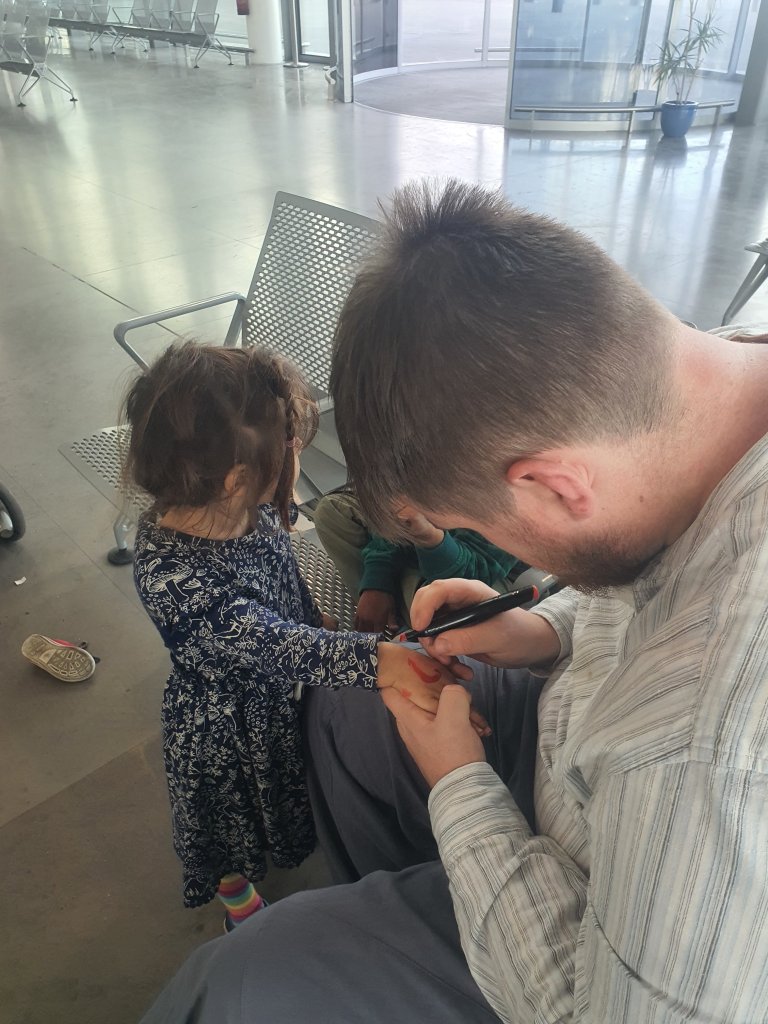
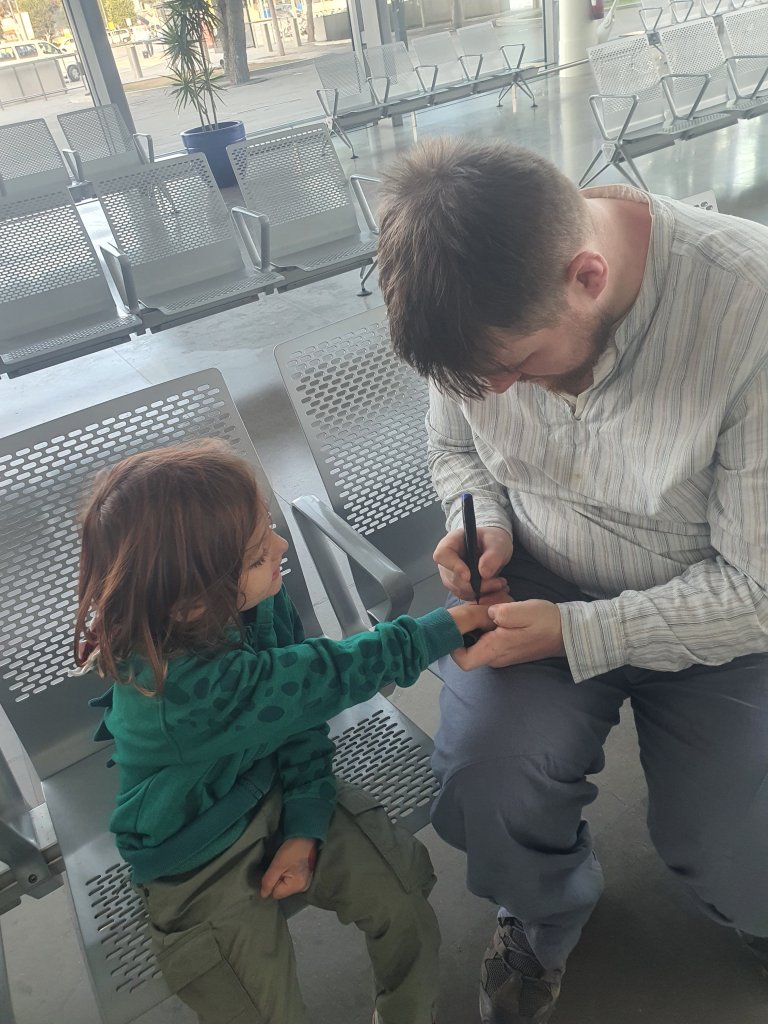
Drawing a heart on each of their hands, one colour for mummy, one colour for daddy; the kids have had a slowly fading inked heart of their hands, which they’ve been able to look at and press, and feel a sense of connection, of love, of wantedness with their dad.

Of course they know they are loved. Every voice message, video call, and hug tells them that.

And yet, there is something powerful in the symbolism of a drawn signature; theirs and theirs alone… to share and compare between brothers and sister, and to remind each other, that they are all loved. They can see it. They can feel it. They, in their childhood wisdom, are able to live in it.

Being away from a parent, regardless of how adaptable a child is, is tough. We ask for a lot of their courage, understanding, acceptance; and often, though the narrative is changing, don’t really sit and think about life from their point of view.

For example; to my kids right now, I’d imagine a collective narrative like this one:

Mummy has moved us all (except daddy) away from our home, into someone else’s (albeit a trusted and loved grandparents home), away from friends, away from toys and parks and spaces we know.
We’ve played and done things, and miss home.
We miss dad.
We miss our toys and television, and our special pillows.
We miss our stained red sofa and the stairs we play slide on.
We also like the parks here, and some of the people we’ve met.
We like having grandparents around, but we also miss our dad.
We see other dads, and wonder why ours can’t be here.
We wonder why money and jobs and houses are so important to the grown ups.
We feel happy and sad and a mix of other things we aren’t sure we have names for… but every day we play and try our best, and we’re with mummy, so we’ll be okay.

Looking at life from their view helps realign my own. It’s how and why I chose to create these love buttons; because simply saying I love you, didn’t feel like enough.

Building Emotional Literacy with toddlers

Meltdowns

Big feelings

Shouting

Hitting

Kicks

Even the odd bite or many!

This is all age appropriate behaviour for young children, usually at varying points and definitely not a one-size fits all kind of thing. Each child will express their emotions differently, and if they’re even the slightest bit like mine, they’ll make sure you know about it!

What makes us so uncomfortable about our children’s emotions? Is it really that we can’t stand them being angry or sad or overwhelmed? Or is it more about our own capacity to hold the space for them.

To quote Hermione Granger, sometimes we as parents have the emotional capacity of a “teaspoon” – usually because we’re burnt out, and we haven’t got a clue how to handle our own feelings, let alone those of our growing child.

So building emotional literacy becomes almost another thing that we should do, but feel we’re not able to. It’s hard, just like most things in parenting… and it’s also not impossible to start small, and build our own with them. That’s what I’ve done slowly, and though it has taken self reflection, journaling, tears and various moments of me questioning my own sanity, I have seen it pay of so beautifully with my own children. Theo, now almost 5 has an incredible ability to tell us about how his ‘bucket’ is feeling, and where the feelings lie, and recently the steps needed to help him feel better – usually involving a drink, hug and time by himself.

This did not happen overnight! It’s taken the literal years of his life for us to learn what helps, and what we need to keep in mind when any of the children are mid-meltdown. I’ve learned is that some things work better than others, and I’m going to share a few things that have worked for us, and a few that still prove to be opportunities for my own growth, alongside the kids.

Name it, Don’t shame it

Name the emotions – yes we’ve likely all heard that this is important. Why? Because a child’s brain and body doesn’t always have the descriptive language necessary to articulate what they are feeling. They don’t know that anger is linked to their tummy discomfort – like a volcano about to erupt. Or that the tight chest they feel and shortness of breath is them worrying, being anxious, nervous or uncertain. They might just feel suffocated, and lash out to make the feelings go away … often to be met with an onslaught of new feelings as the grown up around them tells them off, or another child reacts to their lashing.

Either way, without language, kids can’t cope with their feelings, and when they get told off, shame at their inability to control or understand what’s happening creeps in.

This can look like a suggestion – I see you’re growling at mummy, this makes me think that you may be feeling frustrated. Are you? OR are you feeling upset because I’ve said it’s time to come inside now?
But it can also look like curiosity – You’re growling at me, I wonder what you’re trying to tell me with that. OR when I said that it’s time to come inside, you tried to show me how you feel with a growl, I’m curious to see if we can come up with a word for that feeling.

go a step further

Building emotional literacy also means going a step further. Once you and you child are comfortable naming emotions, then you can chat about where they feel in their body.

We like to make a game of it, not always, but it definitely helps diffuse tensions – for example: “You’re feeling angry right now, is the anger in your knee? Your elbow? Oh no, I forgot, sometimes angry feelings get stuck in our toes – let’s see if we can tiptoe them out

By allowing them to figure out where it feels, and then find a way to release some of the tension around it, we are helping children learn that they have nothing to fear even when they have big feelings in their body. Eventually, they’ll learn how to regulate themselves, at least some of the time. You’re sewing the seeds for emotionally healthy adults, with a much larger capacity to handle their feelings without going into a fight, flight, freeze or fawn response. So this really is a long game – getting it right every time isn’t the goal, modelling and trying again is!

Hold SPace

Allowing feelings has been a big step for me. I read and read and read some more about how important it is to allow kids to have all their feelings in a safe space, without feeling judged. It means they know feelings are normal and that everyone has them, and that makes for healthy adults who don’t hold back feelings or end up in spirals of depression and guilt because expressing feelings is seen as ‘wrong’.

“But feelings can’t be ignored, no matter how unjust or ungrateful they seem.”

– Anne Frank.

And yet, when the feelings seem ungrateful, or extra noisy, or just plain overwhelming. When they are loud or in public or I just don’t really have the time. When the feelings of my children come and I am feeling frazzled or guilty or my own needs haven’t been met, it doesn’t matter how much I know that allowing feelings is important, I just want them to shut-up and change the subject because I am so triggered by it too.

This is the hardest part of holding space. Holding it even when we don’t have anyone holding for us. It’s not their fault they haven’t figured it out yet, it’s our job to guide them… and so regulating even when we don’t feel regulated is the ultimate goal. Allowing them to feel, while maintaining boundaries so they are feeling the feelings without being hurtful – it takes so much practice. Compassion for when we don’t manage it too, because we’re human.

Recently I had a meltdown over one of Ila-Rae’s big feeling moments, being triggered because she was loud, it was late, the baby was tired, I was tired, she was tired, and it was generally just a crappy time for her to be screaming about whatever it was she was upset about. I told her to ‘shut-up’ … and immediately regretted it. Theo actually pulled me up on it and said I shouldn’t use that word, and in the end, I apologised and we had a cuddle; I empathized that she was just frustrated and sad at the situation, and we moved on. In parenting circles, we call this rupture and repair. It has been revolutionary in my own parenting experiences to view things in this cycle.

Apologise

Rupture – repair.

We have a rupture, we shout, we tell our child off, we say something we wish we could take back, and then, what do we do next?

We take a deep breath, some space if needed, and get down on their level, and sincerely tell them we are sorry. We tell them that we are human too, and that we make mistakes, and that no-matter what happens ever, no-matter how angry we may get, we will never stop loving them. We tell them they are incredible, and that they are still learning and we are here to help them.

We repair.

And then we move forward… because sometimes we get it wrong too, and in the big picture, normalising apologising to our children means they will become adults who are not afraid to own their mistakes, apologise and move forward. It’s probably one of the most important things we do in our house, and it does make a huge difference.

Model adult regulation

Ooh this last one is so hard sometimes. Especially when we have triggers from our own childhood that we haven’t really processed yet. Modelling regulation is hard but with practice it does get easier. Plus, there’s a lot of stuff we can do to prepare, or purposely model positive scenarios when we do feel regulated, which mean when react before thinking, and yell or get angry, say things we don’t mean to (my go to is usually along the lines of “for f***s sake, again!”).

The good news is, modelling happens all the time whether or not we plan for it. So when we treat people like our parents, partners and children with respect and kindness, they pick it up. When we talk to kids like we would our best friend, then they learn they are valued as people to us, and they begin to do the same.

There is nothing sweeter that a 2 or 3 year old complimenting you as an adult with all the sincerity in the world, because they think that’s just what everyone does. Or hearing their beautiful little voices tell you about the day or view because you’ve done it for their whole life, and they want to share the joy. All these amazing moments you have, they are because of you, your modelling, your hard work… you are always doing it. Building emotional literacy into this is a step further yes, but it becomes part of life too… and when we model all of the above, we name, we allow and accept, even embrace, we hold the space and apologise for ruptures when we can, we can build some incredible skill for our children, and hopefully, in the long game we will see them be much more emotionally capable and healthy humans.

Kids will be kids

They will bite, kick, hit and scream… because they need to communicate and these are tools of communication.

Our job is not to stop these behaviours because they are ‘wrong’ but rather, to guide them to a new toolkit, with communication skills that mean they can tell us what they need without hurting anyone, including themselves.

Changing my mindset in these ways has helped me immensely, I hope that this may help you too!

#Mumlife isn’t easy…

Finding inspiration to write is not always easy, not is it easy to find time when a good idea hits. These past couple of weeks I have had several “I could do a blog post about that” moments, but inevitably the time passes and I haven’t managed to open up my laptop. Add on to that the fact that TP is extremely possessive of my phone when it is out, these moments pass.

Thinking about that though, about how fleeting moments are, and about how quickly time slips away, is itself, something to share. Recently this has come up a lot for me; the hours and days we wish away. At 27 weeks pregnant now, with a 25 month old, I will be the first to admit that I take a lot of it for granted. I ‘just know’ that tomorrow we can make up for today, or that after nap-time we can do something fun, or that the weather will be better next week for us to go out walking more. I assume that I will continue to be able to run around after my son, and pick him up, throw him around and let him ride ‘monkey’ on my back down the stairs. He sits on my belly and we joke he is sitting on his sister as he climbs onto my shoulders.

On the other side of it though, are the long hours where I thank god and the BBC for Mr Tumble and let TP sit through many, many episodes just so I can eat and cook and do the washing and check my email and maybe if I’m lucky go to the loo before he gets up and demands attention. There are 5am starts and 10pm bedtimes, the food strikes or tantrums for anything other than marshmallows, the milk hunger to the point my nipples feel they might fall off, and the hitting and biting that is his current method of expressing upset and anger. These are moments that I want to pass quickly, because staying present and accepting is hard, it’s easier to wish the hour away and want to ‘move on’ to the next thing on our schedule.

Yet these are also the moments I think back on with a wry smile, because the cuddles and healing that happen after are often the best hugs and cutest conversations. So why do I wish them away?

Because I am tired.

Because I am embarrassed.

Because they make me feel like I am raising a ‘trouble’ child.

Because accepting and dealing with the harder minutes is not easy. Parenthood is not easy.

But it is worth it.

Life with a Toddler: Night Weaning

Letting go of your baby is one of the hardest things a parent will have to do. Allowing them to grow is a beautiful form of torture because while your heart soars for them, it also aches. I am lucky to be a stay at home mum, so I get a lot of time with my toddler, but as a result, letting him go isn’t something I find easy.

My personal parenting journey has been a bit everywhere honestly. I spent the majority of my pregnancy and first year of my son’s life away from my husband, and 8 months into 2nd year of Theo Prana’s life, his dad has missed over half of that time. None of this has been by choice per say, it’s just the way life is for military families; we count our blessings where we can and we know how to make the most of time together.

Even together though, I have been the main carer and it began reflecting in the way that Theo Prana would settle, play and interact. Harrison has been back just over a month now and we moved from Daddy being the fun person who would play all the time, to the person who plays sometimes and keeps coming and going. It wasn’t fair on Harrison, and it was exhausting me. I want to raise my son to know that mummy and daddy can both fix things, feed him, settle him and provide security, even if one is around more than the other; we are both his parents and we both provide for him. That said, I had got used to being in control of the way things ran, so last week, by a little bit of a mess up and a huge nudge from a friend, I left Harrison to do Theo Prana’s bedtime routine – something I have done almost every single night of his life.

I should mention that Theo Prana still nursed to sleep by this point too, and co-slept; the boys were thrown into the deep end, and the water was rough.

They struggled… Harrison will probably remember that as one of the worst evenings he’s had in a long time. Luckily, Theo Prana won’t remember it in the long-term; toddlers are forgiving.

1 week later, Harrison is at work all week and Theo Prana keeps asking for Daddy both day and night. He is almost entirely night weaned with very few complaints until the early hours where I am sure he’s thirsty but refuses water. It feels like a miracle.

20190416_2030206633885642821535968.jpg

Here is how we did it:

*Disclaimer: I am not telling anyone else this will work for them, just sharing my experience. If it resonates, great! If not, that’s okay too… we did what the universe allowed us to do, and what felt right for our family.

Day 1: Bedtime routine went out the window, I was having a rough day, so I told H he could handle things from here and went upstairs to our spare room where my friend was staying. I had a meltdown because of how exhausted I was, and then we listened to the boys watch ‘In the Night Garden’, have a bath, read and finally, go bed. It took 45 minutes to settle Theo Prana. The first night in over a year he had been away from me at bedtime. I spent the first part of the night in his cot and got involved at 2:30am and we co-slept again.

Day 2: Harrison took the lead, and told me to go hide in the spare room again while the bath was running. He did the night routine and half the night; getting to sleep took less than 20 minutes. I slept in the cot again, and got involved at 4:30am, getting back into our bed.

Day 3: I spent the night at a hotel. I slept from 10pm until 6am almost entirely without waking – it was bliss!

Harrison and Theo Prana spent the night on their own, with Theo waking at 3:15am for a short while and climbing into the cot because it smelt like me. It broke my heart to hear but he settled with his dad, and I think this was a huge leap for them both.

Day 4: I put him to bed. Milk downstairs, not upstairs, he screamed and kicked for 50 minutes. I caved at 4:45am and gave him milk.

Day 5: I changed the routine. I fed him in bed, read a book and had him help me plaster over my nipples and say goodnight. It took less than 20 minutes and he slept for 7 hours without needing comfort. He fed again at 6am.

Day 6: Saying goodnight to the milk leads to complaints but not severe; he slept on and off and got milk at 6:45am.

Day 7 (today): Am beginning to think he is having a bit of anxiety over saying goodnight to the milk. Will work on it over the next few days/weeks with extra cuddles and lots of reassurance. He fell asleep in minutes today, was exhausted.

img-20190411-wa00117869524736034859679.jpg

Somehow, we have managed to begin our night weaning process and it is hard but it is working. We have needed this for months now, so I am hoping that this allows me a little extra rest and a break from 4am hunger pangs! I love the fact our nursing journey can continue, but it takes a toll, so this allows us to have the best of both: rest and nursing without making him ‘cry it out’ or suffer. He knew (and knows) he is safe and we will hold him, and that makes a big difference.

If you are trying to do something similar, hang in there! It feels so incredibly difficult but you will be glad you stuck it out – I know I am already, and it is motivating me to keep going.

Dear Mummy, on days parenting feels like a chore, remember this:

Dear Mummy,

I can’t tell you yet, but I see how hard you are working. Some things I won’t understand for a long time, but I do understand that keeping me alive, healthy and happy is a tough job, so thank you.

I love you too. 

Some days are fantastic, some days are long, some days are happy and some days are sad. We have many different types of days together, but the work you do and love you give remains the same: thank you.

Dear Mummy, thank you for all the things you do that get unnoticed.

Thank you for keeping me safe at night, for cuddling me and for kindly waking me up in morning, for helping me changed to get ready for the day. Thank you for letting me choose my trousers, and the colour of my shirt. I like choosing my clothes for the day.

Thank you for feeding me breakfast, and understanding that maybe it is because I had a lot of dinner so I am not very hungry this morning. I know I seem difficult when I turn away from the food, but it’s only because I don’t know how else to tell you I’m full. Thank you for not forcing me to eat at mealtimes.

Thank you for taking the extra time so I can explore as we walk wherever we are going to. I like learning when we are outside.

Thank you for holding me while I nap. I know I am safe in your arms and lying next to you. Thank you for the cuddles when I wake up scared too.

Thank you for hugging me.

Thank you for playing with me

Thank you for reading to me.

Thank you for making bathtime and dinner fun.

Thank you for taking care of me even when your sick.

Thank you for looking after me when I am sick.

Thank you for being in my corner always.

Thank you mum…for everything.

I love you.

DIY Fridge Magnets

Recently, as much as I am happy to spend money on toys/activities for my son, I have wanted to also make things at home.

My latest midnight craft is magnets. Fridge magnets specifically, so that rather than get frustrated when he cannot reach the ones we use to hold notices up, Theo Prana can play with his own set of colourful, felt magnets.

I bought some easy cut magnets from Amazon, and found some felt that I’d bought donkeys ago! Grabbed some scissors, a pen and a bit of PVA glue, and was all set. Oh and of course, I needed a snack too!

20190311_0041579018317711672682942.jpg

I ended up with 12 magnets and added one strip to the back of a (very scratched) kids mirror that he plays with. For now I’ll leave it at that, but I can’t wait to make some with Theo’s own input when he’s older! I think it’s a fab rainy day activity and it’ll be something he can learn with too.