Little voices, Anger and our brilliant brains

You know when they’re little, they say some things but it sounds a little funny because they can’t quite pronounce it yet. Then suddenly, that little difference stops, and we wonder when they learnt to say words the way we do. Every time I hear my littlest talk at the moment, I want to record it all because I want to bottle it up and preserve the sweet accents and voices he does. Of course, that defeats the purpose of being in the moment and actually listening, but I have snuck in a few videos to send family and save as reminders.

I know that these years are fleeting, even when they feel busy. As we approach birthdays, where K will be 2 and P will be 6, I am reflecting on the way they have changed and the language they use. I don’t even remember when it became possible to have such grown up conversations with P, but he’s chatting away nine to the dozen daily, always with a new idea, explanation or request to build something in play. Today we’ve been playing Archelon nests and Ovoraptor mums and I’m struck by how this has become such a norm for us.

P delights in telling me everything about anything; and some of the most interesting conversations happen while he’s chatting away after bedtime, or when we’re out and I can lend him an ear a little more readily as we walk along. He doesn’t get words in as often as he’d like because I’m pulled between all 3 kids, and I can see that it’s having an impact; so when we’re out and he tells me about life and stories, I savour as much of it as I can.

A on the other hand, doesn’t wait for opportunity, she will talk and talk and talk, and has been for years. She really enjoys watching videos on my phone that I’ve taken of them over the years, and sometimes will tell me there’s a specific one I need to see. It gives me the chance to relive some of the best moments, and reminds me why I capture so much when I can; because they change and it feels like forever but also too soon. Hearing her talk on these videos brings to light just how early she’s articulated and narrated her life; and I do sometimes joke that we must have blanked out some months during the pandemic lockdowns because she feels far more grown up.

That said, though I watch my children and marvel at the way they act for their years, I also know they are very much this way because they’ve been given the freedom to grow their voices, challenge us, and come back to safety. I didn’t start parenting thinking this would be the way we parent our kids, but as the years go by, I am more convinced that it’s working well for us. A mix of ideas, lots of trying things out and lots of changes to empower the humans we’re growing with.

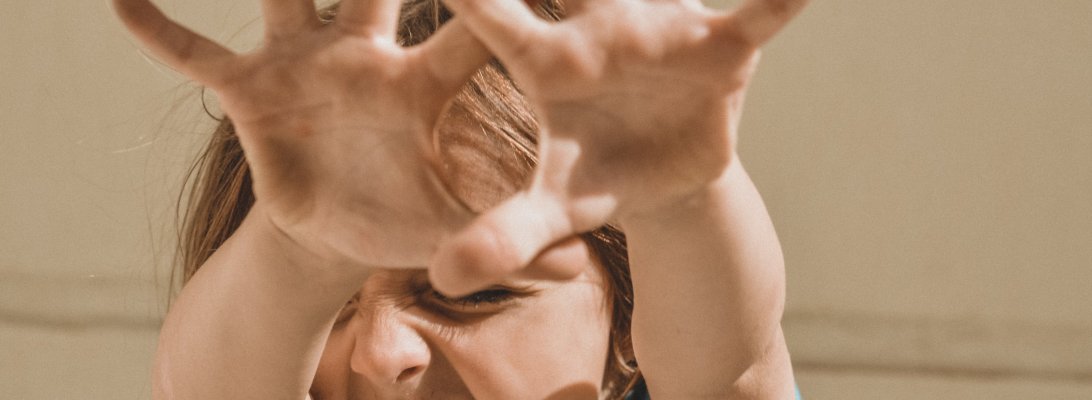
A couple days ago, I asked P to stop swinging and hitting the wall with his feet. A little while later, he got upset with his sister and went to throw a punch. We sat down, he screamed at me and told me he had to go hurt her because she started it. So I said “I get it, you’re so mad right now, your hands won’t even let you stop being angry” and then I showed him how when we clench our fits ready to punch, our body and brain message each other to be angry. Alternatively, when we hold our palms flat, open towards the sky/ceiling, our body and brain send messages of calm.

Fascinated, but still upset with his sister; we turned it into a game where he would do something he knew wasn’t allowed – in this case hit the wall as he swung, and I would be “super, extra anrgy mummy” making a fist, stomping my feet and growling before chasing him until he turned around and opened my palms up to the sky and I’d sigh and relax.

We soon had A involved too and they giggled and giggled at the game; which from my reading about playful parenting, I absolutely took as a good sign on emotional release.

I not only marveled later about this snippet of our day from an emotional regulation perspective, but also through the lens of their little voices. I don’t have the urge to video record everything anymore with P, because he’s chats are so different, but I will bring out the dictaphone we bought to record stories with him; and a while back when he was interested and asked me to, we recorded some stories on a podcast for them to listen to. It’s hardly used, and there are about 4 or 5 I haven’t got round to uploaded yet because the interest was lost; but if they want to pick it up, we can. I loved recording them with him, especially where he’d say the words too, because it really felt like a moment of his voice frozen in a beautiful way. I’ve also used it to record stories for our Yoto player, and that’s been fantastic because they absolutely love listening to library books we’ve borrowed and returned, but preserved for when they are in the mood.

Speaking of our Yoto player, P gave me a quick lesson about how our lungs have trees called alveoli and about how the skin is actually our largest organ. He loves lying down with the player and going through the cards when I am busy with his siblings.

His sister on the other hand isn’t fully into audiobooks, but I have often walked into her reading to herself or chatting away about something in a book, to whom I presume are imaginary friends around her. Her chats are so different to his, and while he tells me how things work, she tells me how beautiful life is. She’ll tell me she loves things, the colours, the shapes, the sounds. She’ll ask to play games with me and then get bored, go find P and I hear them playing a version of things they’ve watched on TV, chatting away and planning roles. It’s the best sound, and one, I really never imagined we’d get to when they would fight all the time.

Home educating them has meant we focus a lot on conflict resolution though, and I can see my attempts and explaining energy and actions are starting to show. I can see how, even though I’ll have to call out “sort it out guys” or step in like with the punching scenario above; they are also learning how to work together. They call themselves a team, and P will say our team has 5 people, but because daddy’s away, it’s got 4 right now until he’s back. It’s a wonderful thing to hear for me, because even though I know it’s his coping mechanism and sounds a little sad, it’s also a beautiful one, and healthier than others from the past. I can see the growth, and importantly, I am learning more deeply that while I have influence over my children as their parent, I cannot control the way they react to situations but I absolutely can do my own inner work and co-regulate with them to build resilience as they get older.

This month has been a rollercoaster, in the same way that many months have been, with changes of direction and disconnection while we each find out feet figuring out what we need. I’m leaning into screen time as a tool for productivity but also for connection; joining them in their joy while they show me what they can do on a game, or chatting with them about the episodes they watch. I’m adapting so that they can have moments of time with me, which had been few and far between since their dad left in April, and I am factoring in, for the first time in years a 20 minute yoga practice that even if it’s midnight, I will make time for.

I tell my kids about their playdough brain; reminding them they can grow their brain and expand their capacity regularly. In doing this, I guess I’ve also been giving myself room to expand my own capacity too; slowly integrating the future I want to manifest for them from a cognitive ideal, to an experience. I have spent years focusing on making sure they know about their brilliant brains, and in doing so, I’m seeing this month how my own brain is brilliant too (and as a reminder to you reading this, yours is brilliant as well).

Wishing you a beautiful day, week and month ahead.

With love,

Rohana x
Do our Children Owe us their happiness?

When we have kids, we don’t think of them and say “I hope they grown up miserable” or wish them miserable years. We wish them happiness, love, good things.

But outside of this aloof wishing process, what does it mean, to wish our children’s happiness? Is it about them, or about us?

I started thinking about this years ago, when I watched a series called This is Us, and the father Jack says he just wants his kids to be “okay” – not fancy or fantastic at anything, but “okay”. In the series, they all have dramatic lives and lots of ups and downs. It’s a fantastic show, for more than just this reference point.

This idea of okayness, versus happiness, versus anything else we’d want for our kids has stayed with me. As I completed our home ed log for this month, reflecting on what we’ve done and not done, things that have happened and feelings that have come up, I thought about happiness again. Do we want our kids to be happy because it reflects on us as good parents? Do we find their emotions, outside of joy, excitement and happiness so uncomfortable that we are willing to do anything to avoid them?

When our kids are upset, they cry. They feel. Often, they may even make a show of it; and then, as if by magic, especially in the younger years, they are done. This is because they allow their feelings to travel through them, to the point where they are no longer dominating their whole being. It can be sped up when we validate them, even if it might escalate things first. It is healing to hear that someone understands that the broken banana or melted ice cream is a valid thing to be upset about; because really these are the big things for our children. They are the things that matter to them, in their world, at this very moment. When their grown ups, or even a sibling or friend see this, and help them feel heard, it means they can process and allow the feelings to travel so much faster.

Yet, so much of the time, we hush it. We dismiss the silly upsets. We tell them to get over it. We don’t see them, or hear how big it is. Because in our world, a broken banana tastes the same and melted ice cream is what you get for taking so long to eat it. In our world, bills and shopping lists and who’s going to make lunch for the beach, medical appointments and insurance paperwork are all far more important than a banana split in half.

But deeper than that; it’s also really uncomfortable to see our kids upset right?

It’s uncomfortable to sit with, or to witness their emotional outbursts; probably because the little versions of us, were never allowed to do it. We were dismissed. Walked away from when tantruming. Told to come back when we would stop whining. Given silent treatments. Or worse, given something to really cry about. Many of us grew up, in all different walks of life, with the same underlying message; feelings of sadness and anger and anything that wasn’t pretty, were not acceptable or lovable. So, to protect ourselves, we buried them.

Now our kids feel it all and we are panicking because we don’t have the tools to navigate through these emotions. So we want to keep our kids happy. Because happy feels safe.

Happy feels comfortable.

Happy means we don’t have to face the discomfort that the more despairing feelings bring.

So when we say, we want our kids to be happy; its a point of thought to consider that this happiness, though of course is us wishing them well, is possibly also a protective mechanism for us. Their happiness is safe. When about us though, it is also selfish.

Though we may want the best for them, we cannot protect them from everything. Just as we have felt hurts and losses and sadness, and possibly struggled through our teenage and adult lives to find tools and techniques that help us cope. Tools that allow us to either feel and resolve, or suppress and forget, so that we can navigate the world without being all consumed in tantrum or rage or floods of tears every time we are triggered. We have had to learn these for ourselves, sometimes with significant time and money spent to do so.

If we take the time, not to wish our kids happiness; but to wish them wholeness instead. If we validate them, co-regulate with them, resource them with tools that will create a bigger balance in their lives, not only at 3 and 5 where they sing a song to breathe and calm down, but when their 15 and panicking over exams or friendship fights, and when their 25 and need to pay rent and buy food and figuring out all the big (sometimes scary), overwhelming things that come as they grow. And when their 50, and 60 and 70 with kids and grandkids of their own.

If we resource our children, to navigate sadness and angry and overwhelm; as well as celebrate being happy and excited, not only are we serving them; we are serving every generation after. We are creating a change that will ripple down our family lines.

Even though, it is uncomfortable to witness our children when they are not happy. It is my opinion that they do not owe us their happiness. Instead, we owe them, the chance to feel it all.

As ever, thanks for reading.

P.S. You are amazing.

Good Kids Communicate their needs

When I wrote the title of this piece, I cringed! It’s inspired by the continuous discussion and questions asked of parents, about whether or not their children are good, because they don’t cry a lot.

Good? Really – what makes a good kid? Is there a set criteria? It’s something I’ve been think a lot about recently, and definitely something that carries so much weight and pressure, as adults who were raised with the notion that good is desirable and that anything else would be ‘not enough’. From a generation that was manipulated into behaviours that got us rewards, the notion of a good kid comes with a hefty price.

But bear with me. I don’t actually think that only ‘good’ kids communicate; instead, its about a sense of safety.

If communication is required in some form, to allow meaningful interactions with others around us, then communication, whether through spoken language, body gestures or other forms non-verbal interactions is a cornerstone of our existence. Therefore, it stands that I will assume, communication in ANY form, is the way that kids communicate their needs.

The caveat here, is that when kids are responded to, they continue to communicate – thus falling into the ‘good’ category (i.e. safe); whereas if they are ignored, neglected, or pushed away, these children often learn that their attempts at communication are a waste of energy – and energy is a precious resource.

Good kids, are kids who, despite it being unpalatable for their grown ups, are safe enough to continue their efforts at communication – they are SAFE in the knowledge that at some point they will be responded to. And so they persist.

But still, society asks if our children are good. They are praised for not crying on an airplane journey. They are hushed when they upset on a bus. They are given screens in public places just to avoid embarrassment; and if this isn’t an option and they act up, they are often labelled ‘naughty’ or ‘bad’ or something equally as ridiculous – either by passers by, or by overwhelmed parents who just want to get out of the situation, often being triggered by the fact that we have been conditioned into the unacceptability of these outbursts of noise. We sometimes even hush their joy for the same reason – fearing it will bother people around.

But it is an outdated idea that good kids are quiet. The notion that good children don’t cry, is actually more telling of the society around us, the expectation that kids should be seen and not heard, that kids – despite being so dependent on us – should never cause inconvenience by crying, or communicating that they require something that puts us out.

Not all kids will do this. Some will, in a last ditch attempt to gain the response, acceptance and love they crave; be extra loud, extra hyper, extra – everything; and again this isn’t effective communication, because they haven’t felt safe.

Truly, as we learn more about children, the way they communicate with their voices, their bodies, their cries. The way that they play and process, and the way that they marvel at the world with eyes so bright – all of the time, communicating. The way that we respond matters. Safe kids, will communicate their needs.

Quiet kids, are often quiet because they don’t feel heard, or feel like they shouldn’t be heard. They have internalized that nobody is going to respond; and so make sure to take up as little space as possible – often becoming adults who do the same and cannot set boundaries, honour their needs or even understand why it’s so hard to communicate with peers/others.

So what makes a good kid? Is there a set criteria?

I don’t think so. I think, though it’s hard, the question we should be asking is about those raising them. What makes a good parent? How do we respond to our children to let them know, even if we don’t fully understand what they are telling us, that we value their communication? What do we do, even when we don’t approve, that let’s them know, all communication is valid, all their needs and wants can be heard, even if that means we say no.

What do you think?

As ever, thanks for reading,

Rohana x

Why did they burn girls mummy ?

International Women’s Day brings lots of feelings up.

Last year, a school friend of mine birthed her gorgeous baby into the world; and though we’ve never gone deep into the story of her birth, I know beyond words she was phenomenal. This year, it was one of my first thoughts – her baby turned 1. What an absolute honour to know women raising women, strong, capable, loved.

What an honour to be surrounded by women, breaking cycles, healing themselves, and birthing their own girls into a world with less to carry forward.

I thought of my friend and her baby. I thought of my own pregnancy and how much carrying a girl forced me to confront fears about raising one.

I thought about how raising a girl has changed me; pushed me to advocate for myself, and to heal – so that she (and my boys) have less to work through; less to weigh them down, and less to pass on again.

I looked at my daughter; awake and asking for breakfast and I thought, today is going to be a good one.

We played and chat, and her brothers woke up; each in their own little world.

I watched her write and thought about International Women’s Day, and what it means to me, and what it might mean to us as a family unit. Should I mark the occasion? I had nothing prepared.

In the end, we didn’t celebrate specifically. We didn’t do any special crafts or read anything because of the day; which I have tried in previous years and have learned, as I dive deeper into the knowing of myself as a mother, that these things (though joyful and purposeful in part) bring stress and discomfort to our group. Instead, we talked; about bodies and women, and how we are most powerful when we can do both what we want, and what is right for the world.

Well behaved women rarely make history

Eleanor Roosevelt

The other day, she asked me about my current read; Burning Woman by Lucy H Pearce, and together with Theo, we spoke about how women (and men in smaller numbers) were burned for magick. They were horrified, without any extra detail – but they asked for more.

Why?

What could I tell them? At ages 5 and 3, how could I explain the privilege they sit on, through the place they live in the world, the tonality of their skin, the reality of job security that their dad has, and the choices we make as a family – they are so damn lucky. And they know it, in part; but at the ages of 5 and 3, I am not going to burden them with the weight of it being so vastly different for so many.

That said, I won’t shy from it either.

Instead, I told them, that the people in power (a little like in Frozen II with Elsa’s grandfather) were – and are – scared of magick. They feared people who knew nature, and who could find food and medicine in plants. They were scared of women who didn’t listen to them, because they wanted to be in charge; and when they weren’t listened to, they got angry. When they couldn’t control the magick people, they decided to call them witches; and hunt and burn them.

But why did they not listen mummy? Why did they want to control them? Who was in charge?

“They didn’t listen because they didn’t want to – a little like when you don’t want to stop playing for dinner; you don’t until you’re ready, and I can’t make you. The difference is, in our family, we respect your bodies, and we try and listen to what you want and need as much as we can. It hasn’t always been like that – and it still isn’t for everyone. Every family has it’s own rules – but now, we don’t burn people for not listening.”

“They wanted to control them because … well why do you think?” – “To be super powerful… like the baddies do, except, were there any superheroes to come save the people?”

Breathe… my 5 year old got me. He may push my limits but he just gets things, and says them in ways that make me need to hit pause.

We carried on talking… about baddies and superheroes, and how in real life it isn’t so simple. Again referencing things they understand; like the Bluey episode where Bandit pretends to be the best in the world, and then admits he’s good at some stuff, not everything. We aren’t bad or good all the time; like when we get angry and hit a sibling, it doesn’t mean we are baddies forever, but it does mean we need to repair.

By the end of our walk and talk; they had a basic idea that people were burned because they weren’t understood; and because the people in charge (who are kind of a mystery and “shouldn’t get to decide for everyone”) were scared of them. It wasn’t something I’d anticipated, so navigating it like this felt enough without too much.

I’m glad we’ve begun to raise our daughters more like our sons, but it will never work until we raise out sons more like our daughters.

Gloria Steinem

Today, I didn’t bring up the burning woman conversation from last week. I could have to anchor in points but I don’t think I need to, they’ll show me what they remember and need in time. We settled on talking about how we can support girls and women to listen to our bodies by doing it ourselves and making healthy choices – and about consent and body boundaries for everyone. We chat about how when we do what we want, but that is also right / good for the world, we are celebrating people, and the earth.

And we talked about how boys and men need support to; but that sometimes they need it for different reasons – so they have a different celebration day.

It’s a day that is so important to facilitate conversations; it’s a day that we speak truths that often get hidden otherwise; it’s a day where there is a little less fear about being burned, because we are all shouting ‘smash the patriarchy’ together.

But it’s a day.

This work is lifetime. This day is a drop – and we need lots of drops to make the ocean.

Raising humans is political, and nothing hits home harder than this on days where we discuss equity – because in raising them; we set the standard. Our standard here, in our slow, intentional, play filled life, is to dismantle the power of patriarchy and capitalism that links women’s’ worth to her productivity or reproductive capacity. It is to remind my sons and daughter that every single feeling is to be felt; every part of them is important, and every minute they are loved – because if we have a generation of kids who know their power; they will raise more kids who know their power – and systems that do not serve for good will collapse.

As always, thanks for reading

Rohana x

The rollercoaster of Motehrhood

Motherhood is a marathon. It’s sweaty and exhausting and often filled with various bodily fluids, not many of them our own. We often find that we are in a cycle of doing and being for everyone else, wearing the same clothes for days or holding back hair while our kids are sick even when we just want to throw up too!

But somehow, despite doing all of the things, often on little sleep and a vague remembrance of what it feels like to have a full cup, we begin to wonder if we are enough.

Am I doing enough?

Am I cooking enough ‘good’ food?

Is the house clean enough?

Do I cuddle my children enough?

Have I been a ‘good enough’ partner recently?

Have I even thought about all the birthdays or friends or the appointments I need to book?

Am I enough? Or am I screwing up?

It’s exhausting!

The mental load of motherhood is enough to break us. We feel guilt glands grow with every ‘to do’ and every ‘should’; and eventually, we end up feeling like we just can’t cope – but that there’s also no way we can stop.

You are holding everything together; almost exclusively at times; with not even a thank you or any notice taken. You are not a superwoman, but you are being asked to be.

But what if there was another way? What if we could, at least, shift the guilt.

Move away from the guilt that we aren’t enough – because my goodness we are!

Our inner critic roars when we get frustrated by broken bananas and bedtime battles; because we are so stretched at every angle, that we cannot see how adding more big feelings is possible. Every time our inner critic pipes up, we buy into the belief that we ‘should’ be doing more.

I call bullshit!

And, in fact; I call so much bullshit, that I created a course on this exact topic. The Rollercoaster of Motherhood in all it’s messy madness doesn’t have to include guilt over not enoughness. It doesn’t have to include overwhelm at all the things society tells us we should be. And it doesn’t have to include days after days where we feel like we are failing; just because we haven’t met the impossibly high standards we (or others) have set for ourselves.

If you’re interested to learn more; contact me. I will be opening opportunity later this year, to work with mothers, and families at a much deeper level than I have been writing; because I believe it’s time we reclaim the power we have raising our children. Reclaim the political act that parenting is; not just so we move away from not feeling enough – but so that our children have better, more positive writing on the walls of their mind.

As ever, thank you for reading. You are amazing!

Rohana

Do We Have to Fill Our Own Buckets?

Self care has become an entire industry, and I am by no means the first nor will I be the last to call out the absolute exhaustion this brings to mums.

To women and men everywhere to some extent I’m sure, but to mums especially, when we are bombarded with messages about the importance of self care, to then have to add it as yet another thing we ‘should’ be doing.

What does self care look like? It used to be marketed as face masks and bubble baths; but with the ever increasing growth of the mental wellness industry, I am seeing it start to look like suggestions for meditation and relaxation – both of which, I absolutely value; and both of which, when I feel like I ‘have to’ do them, begin to become things I resent.

My kids have a book, about buckets and happiness. It’s called ‘Have You Filled a Bucket Today?’.

The book suggests, in a nutshell, that every single person has a bucket (invisible of course) with joy/happiness and good feelings; and every single person has the potential to fill or empty buckets – others and their own. The essence of the story, is that when we fill up the buckets of others; with good deeds and kind words, we unintentionally fill our own buckets as well. However, if we dip into buckets, then ours also begin to empty.

It’s become a frequent reference in our home, often when we ask, “are you dipping or filling a bucket with this action right now?”

I mentioned the book, because, as I have thought about self care, buckets, cups and other various metaphors regarding our personal capacity for cultivating and nurturing our own joy, I’ve thought about the idea that we are responsible for filling our own buckets.

A friend wrote beautifully to me recently, about how the 10 minutes of yoga, the walk with a podcast and the hot tea or shower alone are not really ways to fill her cup, but more like armbands while she is trying to get to shore. She inspired me, and her words prompted me to dig deeper; because we all have these armbands, and we hold on to them because if they are taken away… well, it’s a slippery slope right? I learned that it was for me anyway.

These armbands aren’t enough though. Not long term. They are literally just keeping us afloat. In fact, my friend also wrote that, though its exhausting now, it won’t be forever. And so, after a few more conversations, I began to think about receiving.

I messaged another friend, and told her how my children are currently in phases where they’ll feed me, or teach me things we’ve done together, while I pretend not to know – and this brings them joy. Not only because they are showing their knowledge, but because they are sharing, giving to me, in the way that I have naturally given to them all their lives. In the way I have modelled relationships work. They, as they grow, are giving back.

So it’s now my job, to also model receiving.

As mums, self care is often a to-do on our list. Something we have to do for ourselves, often coupled with the pressure that we need to teach our children to look after their own needs by doing so ourselves. It is more of a requirement, a should, a must-do … and then often, we come back to more chaos, which puts us off trying the ‘self care’ activity again.

I propose then, that the problem isn’t in the self care specifically, but rather in our conditioning that it must be done for us, by us, alone.

What if instead – we opted to receive self care? Maybe in the form of pre-prepped meals, which eases time constrains and allows us to pick up a book?

What if we received help with the housework, and it wasn’t done to our standards, but it was done – and so we could have a bath?

What if, we chose to ask for someone to organize the weeks plan, while we fill our cup creating or moving our bodies?

These may not be all-inclusive holidays in the Bahamas, but by asking for help – and being open to receiving it, even if it means a change in the standards of clothes folding or toys away, we can move from armbands helping us float, to the a paddleboard we are riding to shore?

Do we really have to do it all ourselves? Or can we let others fill our bucket too, because lets be really honest, how much of your day/week/lifetime, do you spend giving to others, so you can fill their buckets first?

With love,

Rohana

P.S. In case nobody told you today, you are loved, important, and so much more than enough.

Did I Screw up?

Chatting about the past few years, experiences, opportunities, covid and all the craziness that brought, I text my partner, “I wonder how much I’ve screwed up?”

“You haven’t screwed up darling” he responded in a heartbeat. Always there, encouraging me… even when we have no idea what to do next. I am grateful.

I haven’t responded yet, I decided to write this instead!

Truthfully, I have screwed up. We all do at times. In my journey as a mum, I’ve screwed up on many occasions – but what I’ve learned is, that the rupture isn’t as important as the repair.

I sat on my bed earlier this summer, and I cried. My daughter – at 2 years old – asked me what was wrong, and I told her that I was sad and angry and that I had some big feelings … or something like that; I was upset because I felt overwhelmed at something. Her response will stick with me always:

She cupped my face in her hands and said, “It’s okay mama, I have big feelings too sometimes, but you help me with them. You’ll be happy later”

She just got it. It didn’t matter why I was upset, or who was to blame. It didn’t matter what was screwed up. It didn’t matter if the dishes didn’t get done or the clothes stayed out. It didn’t matter.

What mattered was the cuddle. The laugh. The cry and the release. The repair.

A few weeks ago I decided to release a course online. On motherhood, on guilt, on navigating the not-enoughness we feel. On reframing the narrative and celebrating ourselves.

Yet here I am, sharing vulnerably, that I still feel not enough. I need my support systems; I have built a framework, for myself, that brings me back to a mindspace of celebration, gratitude and joy. I’ve learned this year, more than ever, that no-matter what I feel like I screwed up – there is always joy to be found.

It is not the screwing up that matters; it is how we choose to repair it.

Tonight, my worries and thoughts have come from past events; so repair isn’t as easy as saying sorry and moving forward. It requires intention; planning, and attention to my children’s needs now.

Repair is powerful; saying sorry has been one of the biggest tools in my toolbox. Repair also requires forgiveness; of myself. Self compassion, knowing I absolutely did the best I could, with what I had, at the time, and a big hug! Havening myself tonight has been a source of comfort for sure.

We all screw up. I did. I have. I will.

I feel it more right now I think, as I look towards sharing my toolbox with others, even though I am still in the messy middle of feeling my big feelings too.

But no-matter what, I know I can look at my babies, as they sleep, and feel deeply, that we are all doing the best we can, whatever that means for us right now. And that, in my experience, makes all the difference.

Xoxo

Rohana

Love Buttons and Goodbye Hugs

Last week the kids said goodbye to their dad again… a relatively regular occurrence for our family, like any military family will know. For us though it doesn’t usually involve a plane, and for the first time since Theodore’s birth, it was him saying goodbye to return to the UK, while I stayed in Gibraltar with our children.

They know that he works long hours, nights away, weeks away, and part of his job (although it hasn’t affected us in recent years – for which I am grateful) is going away for months at a time. It’s part of life with him being a submariner. A life without daddy is unimaginable; but a life where he isn’t around all the time, its the norm.

We’ve stayed in Gibraltar, after being here since the early autumn, actively making more moves towards changing the direction of our life, away from a life we had planned in the UK. It’s a tumultuous turn of events; one even 6 months ago I had never imagined would be our reality, and yet, in my bones I know that this is our destiny. To change. To shift. To grow something more than what our current life offers.

So last week we said goodbye, and we did something new; a little ritual that provided a wholesome, connected farewell, and has been a source of comfort throughout our week.

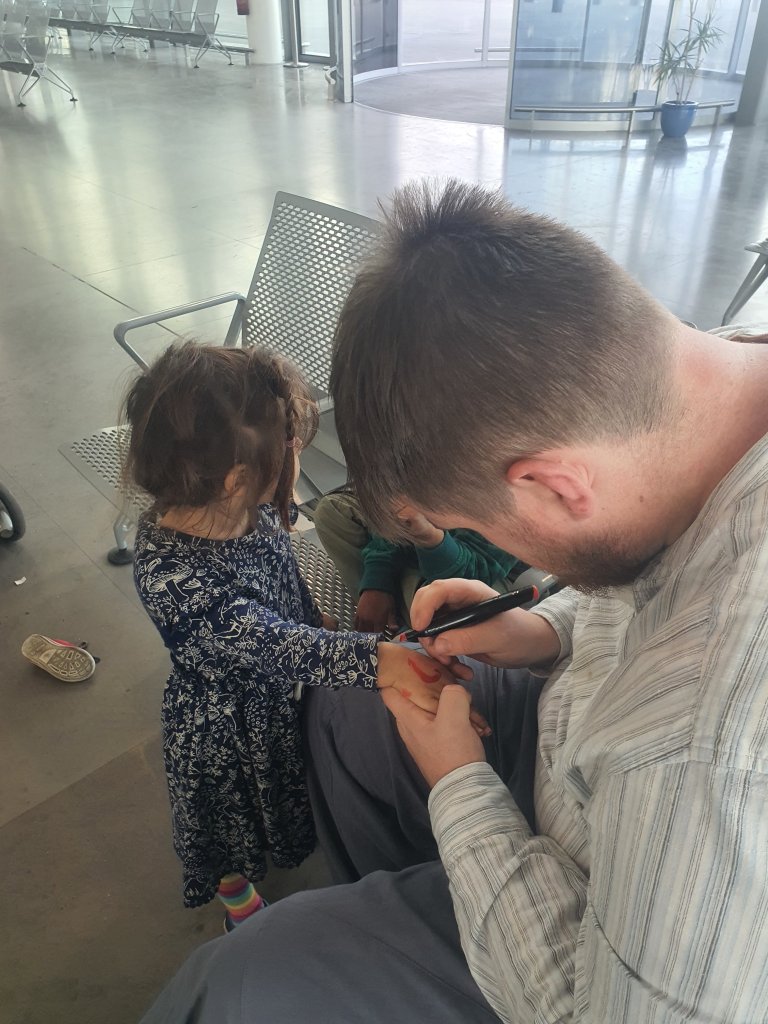
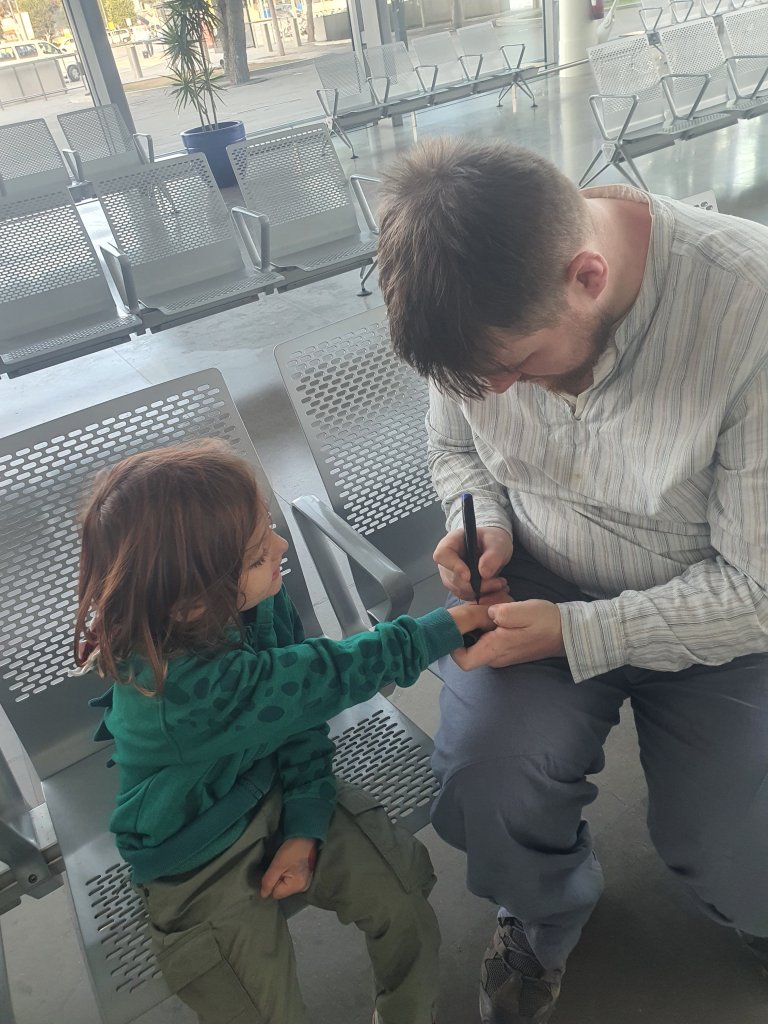
We gave the kids, love buttons.

Yep, they are as cute as they sound, and totally harmless.

Drawing a heart on each of their hands, one colour for mummy, one colour for daddy; the kids have had a slowly fading inked heart of their hands, which they’ve been able to look at and press, and feel a sense of connection, of love, of wantedness with their dad.

Of course they know they are loved. Every voice message, video call, and hug tells them that.

And yet, there is something powerful in the symbolism of a drawn signature; theirs and theirs alone… to share and compare between brothers and sister, and to remind each other, that they are all loved. They can see it. They can feel it. They, in their childhood wisdom, are able to live in it.

Being away from a parent, regardless of how adaptable a child is, is tough. We ask for a lot of their courage, understanding, acceptance; and often, though the narrative is changing, don’t really sit and think about life from their point of view.

For example; to my kids right now, I’d imagine a collective narrative like this one:

Mummy has moved us all (except daddy) away from our home, into someone else’s (albeit a trusted and loved grandparents home), away from friends, away from toys and parks and spaces we know.
We’ve played and done things, and miss home.
We miss dad.
We miss our toys and television, and our special pillows.
We miss our stained red sofa and the stairs we play slide on.
We also like the parks here, and some of the people we’ve met.
We like having grandparents around, but we also miss our dad.
We see other dads, and wonder why ours can’t be here.
We wonder why money and jobs and houses are so important to the grown ups.
We feel happy and sad and a mix of other things we aren’t sure we have names for… but every day we play and try our best, and we’re with mummy, so we’ll be okay.

Looking at life from their view helps realign my own. It’s how and why I chose to create these love buttons; because simply saying I love you, didn’t feel like enough.

Building Emotional Literacy with toddlers

Meltdowns

Big feelings

Shouting

Hitting

Kicks

Even the odd bite or many!

This is all age appropriate behaviour for young children, usually at varying points and definitely not a one-size fits all kind of thing. Each child will express their emotions differently, and if they’re even the slightest bit like mine, they’ll make sure you know about it!

What makes us so uncomfortable about our children’s emotions? Is it really that we can’t stand them being angry or sad or overwhelmed? Or is it more about our own capacity to hold the space for them.

To quote Hermione Granger, sometimes we as parents have the emotional capacity of a “teaspoon” – usually because we’re burnt out, and we haven’t got a clue how to handle our own feelings, let alone those of our growing child.

So building emotional literacy becomes almost another thing that we should do, but feel we’re not able to. It’s hard, just like most things in parenting… and it’s also not impossible to start small, and build our own with them. That’s what I’ve done slowly, and though it has taken self reflection, journaling, tears and various moments of me questioning my own sanity, I have seen it pay of so beautifully with my own children. Theo, now almost 5 has an incredible ability to tell us about how his ‘bucket’ is feeling, and where the feelings lie, and recently the steps needed to help him feel better – usually involving a drink, hug and time by himself.

This did not happen overnight! It’s taken the literal years of his life for us to learn what helps, and what we need to keep in mind when any of the children are mid-meltdown. I’ve learned is that some things work better than others, and I’m going to share a few things that have worked for us, and a few that still prove to be opportunities for my own growth, alongside the kids.

Name it, Don’t shame it

Name the emotions – yes we’ve likely all heard that this is important. Why? Because a child’s brain and body doesn’t always have the descriptive language necessary to articulate what they are feeling. They don’t know that anger is linked to their tummy discomfort – like a volcano about to erupt. Or that the tight chest they feel and shortness of breath is them worrying, being anxious, nervous or uncertain. They might just feel suffocated, and lash out to make the feelings go away … often to be met with an onslaught of new feelings as the grown up around them tells them off, or another child reacts to their lashing.

Either way, without language, kids can’t cope with their feelings, and when they get told off, shame at their inability to control or understand what’s happening creeps in.

This can look like a suggestion – I see you’re growling at mummy, this makes me think that you may be feeling frustrated. Are you? OR are you feeling upset because I’ve said it’s time to come inside now?
But it can also look like curiosity – You’re growling at me, I wonder what you’re trying to tell me with that. OR when I said that it’s time to come inside, you tried to show me how you feel with a growl, I’m curious to see if we can come up with a word for that feeling.

go a step further

Building emotional literacy also means going a step further. Once you and you child are comfortable naming emotions, then you can chat about where they feel in their body.

We like to make a game of it, not always, but it definitely helps diffuse tensions – for example: “You’re feeling angry right now, is the anger in your knee? Your elbow? Oh no, I forgot, sometimes angry feelings get stuck in our toes – let’s see if we can tiptoe them out

By allowing them to figure out where it feels, and then find a way to release some of the tension around it, we are helping children learn that they have nothing to fear even when they have big feelings in their body. Eventually, they’ll learn how to regulate themselves, at least some of the time. You’re sewing the seeds for emotionally healthy adults, with a much larger capacity to handle their feelings without going into a fight, flight, freeze or fawn response. So this really is a long game – getting it right every time isn’t the goal, modelling and trying again is!

Hold SPace

Allowing feelings has been a big step for me. I read and read and read some more about how important it is to allow kids to have all their feelings in a safe space, without feeling judged. It means they know feelings are normal and that everyone has them, and that makes for healthy adults who don’t hold back feelings or end up in spirals of depression and guilt because expressing feelings is seen as ‘wrong’.

“But feelings can’t be ignored, no matter how unjust or ungrateful they seem.”

– Anne Frank.

And yet, when the feelings seem ungrateful, or extra noisy, or just plain overwhelming. When they are loud or in public or I just don’t really have the time. When the feelings of my children come and I am feeling frazzled or guilty or my own needs haven’t been met, it doesn’t matter how much I know that allowing feelings is important, I just want them to shut-up and change the subject because I am so triggered by it too.

This is the hardest part of holding space. Holding it even when we don’t have anyone holding for us. It’s not their fault they haven’t figured it out yet, it’s our job to guide them… and so regulating even when we don’t feel regulated is the ultimate goal. Allowing them to feel, while maintaining boundaries so they are feeling the feelings without being hurtful – it takes so much practice. Compassion for when we don’t manage it too, because we’re human.

Recently I had a meltdown over one of Ila-Rae’s big feeling moments, being triggered because she was loud, it was late, the baby was tired, I was tired, she was tired, and it was generally just a crappy time for her to be screaming about whatever it was she was upset about. I told her to ‘shut-up’ … and immediately regretted it. Theo actually pulled me up on it and said I shouldn’t use that word, and in the end, I apologised and we had a cuddle; I empathized that she was just frustrated and sad at the situation, and we moved on. In parenting circles, we call this rupture and repair. It has been revolutionary in my own parenting experiences to view things in this cycle.

Apologise

Rupture – repair.

We have a rupture, we shout, we tell our child off, we say something we wish we could take back, and then, what do we do next?

We take a deep breath, some space if needed, and get down on their level, and sincerely tell them we are sorry. We tell them that we are human too, and that we make mistakes, and that no-matter what happens ever, no-matter how angry we may get, we will never stop loving them. We tell them they are incredible, and that they are still learning and we are here to help them.

We repair.

And then we move forward… because sometimes we get it wrong too, and in the big picture, normalising apologising to our children means they will become adults who are not afraid to own their mistakes, apologise and move forward. It’s probably one of the most important things we do in our house, and it does make a huge difference.

Model adult regulation

Ooh this last one is so hard sometimes. Especially when we have triggers from our own childhood that we haven’t really processed yet. Modelling regulation is hard but with practice it does get easier. Plus, there’s a lot of stuff we can do to prepare, or purposely model positive scenarios when we do feel regulated, which mean when react before thinking, and yell or get angry, say things we don’t mean to (my go to is usually along the lines of “for f***s sake, again!”).

The good news is, modelling happens all the time whether or not we plan for it. So when we treat people like our parents, partners and children with respect and kindness, they pick it up. When we talk to kids like we would our best friend, then they learn they are valued as people to us, and they begin to do the same.

There is nothing sweeter that a 2 or 3 year old complimenting you as an adult with all the sincerity in the world, because they think that’s just what everyone does. Or hearing their beautiful little voices tell you about the day or view because you’ve done it for their whole life, and they want to share the joy. All these amazing moments you have, they are because of you, your modelling, your hard work… you are always doing it. Building emotional literacy into this is a step further yes, but it becomes part of life too… and when we model all of the above, we name, we allow and accept, even embrace, we hold the space and apologise for ruptures when we can, we can build some incredible skill for our children, and hopefully, in the long game we will see them be much more emotionally capable and healthy humans.

Kids will be kids

They will bite, kick, hit and scream… because they need to communicate and these are tools of communication.

Our job is not to stop these behaviours because they are ‘wrong’ but rather, to guide them to a new toolkit, with communication skills that mean they can tell us what they need without hurting anyone, including themselves.

Changing my mindset in these ways has helped me immensely, I hope that this may help you too!