
Talking to kids about grief is a big topic, and it’s often one that many parents find hard. Most adults steer conversations away from grief, or are awkward when it comes up. So talking to children is even harder.
And it’s even more important.
These are my reflections of our experience of losing my parents dog, how it’s impacted my children and how it’s opened windows into conversations that we’d have otherwise probably not have had.
Last year, we spent a few months in Gibraltar living with my parents, and consequently my childhood dog who was 17 years old by that point. Soon after we came back to the UK, my dog (Lucky) died.
I didn’t bat an eyelid. Mum messaged me, and within the same hour I told my kids.
In my view, an hour, or day or week wouldn’t make a difference, except that I’d be lying by omission with absolutely no reason to. I knew it would be sad and hard, and I also knew that they would need the time to process it; so by telling them straight away, I could have my feelings and then be able to hold space for theirs when they came through in full force.
This proved to be an extremely valuable decision for us, because by the time the big feelings came a week later; I’d been able to light a candle, say a prayer, and celebrate the life and joy my dog had brought. It gave me the mental space to hold them, hear them, and also steer them through their grief. Yes she was a dog, not a person, but she was family, and they felt the impact of her loss deeply.
We had read books on death before, and regularly spoken about the circle of life, and we’d told the kids that Lucky was old in her bones. She slept a lot. Was slow. We knew it was coming.
They loved her. In the short spurts of time they’d spent with her, she left her pawprint in their hearts; especially my oldest who met her for the first time when he was 5 days old. She’s a part of their story, and their first real experience of death and grief.
When it hit them, the kids cried. They asked what would happen. They asked where she’d go. We spoke about different traditions, and how she specifically had been cremated so her ashes would return to the earth and new life would bloom where she was laid. Our favourite book was The Endless Story which is illustrated beautifully.
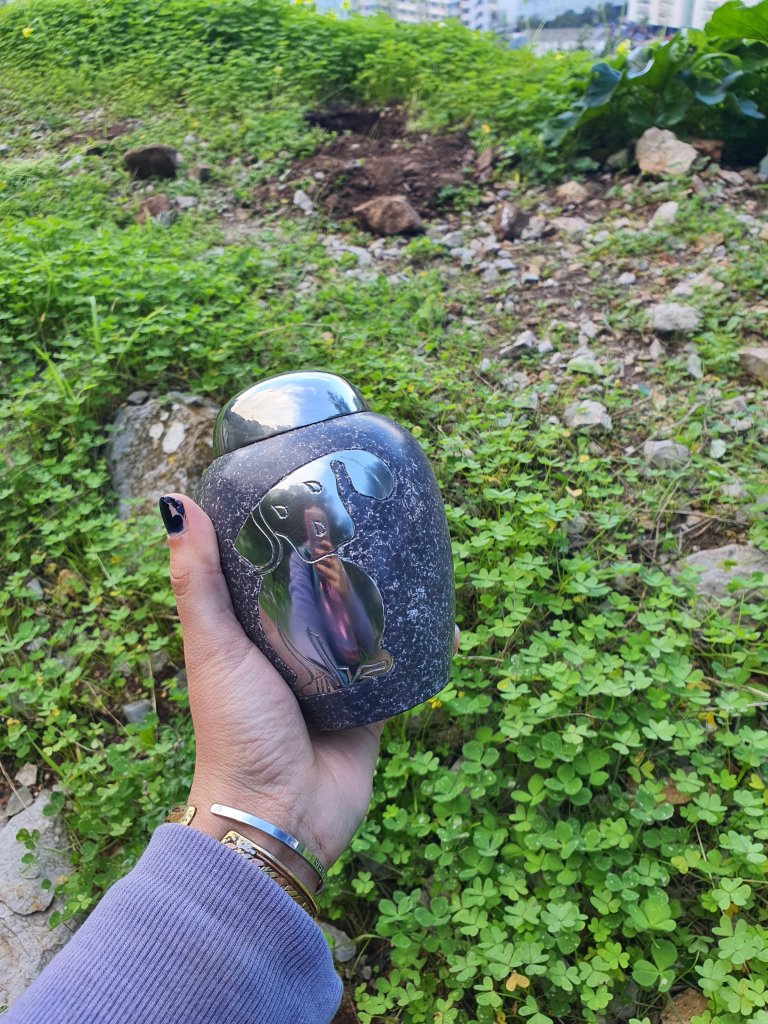
My parents kept her ashes and when we went back to Gibraltar, we scattered them together. We spoken about the grass and flowers, and how the ashes would seep into the soil, and be a part of the process to create new life. We spoke about how some people (including me) believe in reincarnation.
There were many tears. There was a lot of very audible and visual grief… and I told the kids to let it all out. They could be as sad as they wanted, in whatever way felt right to them.
My daughter collected flowers and cried. My oldest son sobbed and shouted, and said he wished we could be immortal jellyfish so we’d never die. My younger son wasn’t sure… he was too little really. But he was there, and that mattered. My parents and brother were with us of course, and they held my children, shared some fun stories and shared in sorrow too. It was a hard and important day.


That was 6 months ago.
With his recent birthday, P woke up several times in the weeks leading to it, with sobs of not wanting to get old because getting old means we are closer to dying.
Since then, topics of saddness, missing loved ones, wishing nobody would die, worrying that we’ll all get old and die, wanting to be cremated together and various other aspects of death have since become a part of our life. At any given moment, sometimes close together, sometimes with weeks in between, they’ll make a comment, or get quiet, or have a wave of tears about Lucky being dead. A (aged 3) has commented and cried things like “I didn’t want Lucky to die” or “I wish I could stroke Lucky again” … but her process has been straightforward for me, we’ve cuddled, cried, sonerimes shell ask for a story of when Lucky was little or for me to tell her about when she’d help my dad with dog walks, and then that’s it. P (aged 6) on thr other hand, has not been so straightforward; like with pretty nuch everything, his high sensitivity has really shone through.
The way I’ve been managing this has varied; sometimes it’s just a case of listening, reflecting back what he’s said, and then holding him through it. Reminding him that I am here and these feelings are normal. He often will spend a few minutes here in this space and then enter a new conversation with me or say he’s ready to play.
On his birthday, he said when we die, we disappear forever, and so I brought in the concept of memory keeping us alive, and about how people leave their legacy; I specifically said about how people that invent things might live on through their inventions or discoveries, like gravity and electricity, or through movies and stories like Vikings, or through preservation like the dinosaurs. All of those creatures/people might be dead, but we haven’t forgotten them. This worked remarkably well, and he visibly relaxed as he worked out that we fly planes and take pictures and drive cars, even if the people who invented them lived long ago.
Lastly, if it’s a really hard one, or a particularly big feeling, like when P says he wants us to all be immortal jellyfish, or when he tells me that he’s scared he won’t come back and be with the same family, I remind him he can choose what to believe. They there’s no right or wrong, and that nomatter what, we are here now, making the best of it. Usually this also involves cuddles or closeness too, something I’m particularly aware of because I want him to feel safe through the feelings.
Chatting about the grief has open windows of conversation, and we’ve spoken openly about how grown ups come back and that also not always. We’ve spoken about safety first in situations like climbing or jumping or in the car. We’ve spoken about age, and how age isn’t the only factor in death.
Mostly the emphasis is on saying thank you to the earth; for growing more and blooming, and showing us that there really is a circle of life.
As ever,
Thanks for reading xx
Rohana
 Supporting you from pregnancy to parenting