I have been avoiding this; so here I am day 1 of 40. Committing to myself, possibly as a way to, once these days are done, say goodbye to my blog and move elsewhere.
I have no idea what I’ll write over 40 days, but tonight, I’m musing over commitment, and how, I am so deeply committed to some things, but then others are so goddamn hard. I commit to projects, or people and last year I deeply committed to my own personal practice. This year though, I have tried and tried and continuously found myself avoiding or excusing a lack of consistency.
Perhaps it’s the lack of novelty that my ADHD brain thrives of.
More likely, I think it’s fear. Showing up for myself was a fun experiment last year… but this year, it feels like IF I show up and ask myself to stretch, I might actually grow and change is hard. My type A control freak inside is squirming… because ultimately everything about this year has screamed a lack of control.
From an unexpected, joyfully (and quickly) manifested pregnancy that has me on the path to meeting our 4th baby soon, to a house move, new courses and opportunities, healing work that I have delved into and research that has me continuously taking notes, feeling triggered, and requiring space from. My kids have kept me on my toes more than ever and friendships have evolved through heartbreak, joy and curiosity. I am genuinely in love with my life, and also feel like there’s a whirlwind going on, and I have to accept that none of it is within my control.
So committing to this, 40 days of writing… is within my control. And that is scary! And exhilarating.
Tonight; my ramble on commitment has lead me to this thought: When I commit to myself, I heal the spaces where my ancestors didn’t have the opportunity to show up for themselves in this way, and I pave new paths, create new neuropathways in my brain, and in small steps, create spaces for my children and those afterwards, to commit to themselves with more ease. I am doing this work slowly, one trembling, uneasy, curious baby step at a time.
I like the idea of that, because when baby’s start to walk, though they are bold and headstrong, they are also trembling… and committed. The intrinsic motivation of a little person taking their first steps is one of the most incredible things to see… doesn’t matter how much they mess it up, they keep coming back, and of course they do it.
If I consider my commitment to myself over the past 6 months like that; it’s kinder, more graceful… it’s been a lot of hesitant steps, backing away, and now I’m trying again.
I wrote this more than a yearago … for some reason, I thought it wasn’t right to share at the time. Perhaps because I felt raw from the day, or perhaps because I got busy … either way, I’m sharing it now. Because as I read it back, I realised just how much I needed my own words today… and I am so immensely grateful that I have this space to write.
With love, from a past version of myselfxox
” I was on the bus today, and of course, bus trips mean lots of people. Always opinions, some lovely, others not; but more recently, as I’ve been building up to solo trips with the kids again in the better weather, with them all being older, and E, now 20 months having lots more opinions about the buggy; I’ve thought about how we use the time travelling to connect.
Today, we played I-spy, our version of the game, using colours instead of phonics, and sometimes throwing in the odd shape or physical reference like ‘tall’ or ‘wide’ instead. The kids sat, and looked around, and E started to whine because he was strapped into the buggy. Luckily, another mum got on, and the connection between him and her daughter began, until he fell asleep!
We (mums) chat for a while, talking about kids and coping; she shared some wisdoms about being a mum of 7, and I shared some frustrations about villageless parenting. We connected – over the shared experience of splitting ourselves into multiple pieces, stretching so our children could have parts of us, and simultaneously loving the chance and choice to do this, and being exhausted by it. I told her I thought her family must be beautiful, and I admired her honesty. She told me that it gets easier and harder, affirming that no choice is right, but that we do what we can with the knowledge we have.
A brief, meaningful chat, interrupted by a gentleman getting on the bus and sitting down adjacent to my older 2. “you’ve got your hands full” he said gruffly to me.
“Oh I really do” I replied. “Full of love with my amazing children”.
“Uh, not all the time I bet” was his response!
The other mum looked at me and we shared a moment of horror at the roughness in his voice.
“They really are amazing” I told him. It was our stop. We left.
And once again, I thought about connections. Some positive, some negative, all, inevitably will have an impact on our energy fields. Why do some people feel so harshly about children? Why do they judge when there is more than 1? What did he gain? What was so triggering for him? I wondered aloud a little, with the general cautionary calls to my kids about the road. I thought about how hard it might be for some people to see kids being so free and confident, when they might have never been given the chance to be so.
I wondered how my children felt. Though they know we’ve had these comments and conversations before, so they said they were hardly ruffled, more interested in the scrap metal yard instead. But how does this impact children? How do we make them feel when we comment about how hard they are constantly?
What message do we send when we say, I’ve had enough of you? Because in most instances they never get to say that to us.
Thinking about my children, and the brief beautiful encounter with this lady, I remembered a quote I’d read in an email this week by Rupaul that “You’re born naked and the rest is drag”.
Kindness costs nothing.
The appearances we choose every day impact every single human around us. We are born naked, and needing others to survive… as we grow we create costumes for ourselves every season of life… and yet, when we die, we return to the earth .. dust. The short space of time in between, in the costumes we choose may be brief, but it is so powerful.
The lady on the bus today gave me hope… and it was thanks to her, that though the gentleman’s words stung, I could brush them away, and hold my babies close. A year ago, I might have been brought to tears (probably would have!). Thank you, whoever you are. I am grateful.”
That’s it.
That’s the post. A short meeting that left a big impact.
Whatever your day looks like. Wherever you are in the world. I hope you know this:
You are loved. You are important. You are so much more than enough.
I’m currently taking a Chinese medicine course, all about Traditional Chinese Medicine in relation to women’s health.
When I read about it before buying, it sounded fascinating.
Now, taking it, I’m really struggling to understand anything, and as a result, I’m putting off the study. There’s so no dopamine hit at completing units because I think I’ve understood it, and then realise I’m still very confused.
I’m learning about myself as I go though, because nobody is making me do the course. I could quit. Nobody would hold me accountable, and yet, I’m continuing – at snails pace – knowing that if I keep at it, by the end, things should fall into place and I’ll understand.
I’ve got pieces of the puzzle, but not the big picture yet.
As I watch this unfold in my own life, I’m also reflecting on our home education styles and where my children are at. P is 6 and he isn’t reading or writing yet, he can recognise letters, and even some words, though will often choose to say he doesnt know. A is 3 and showing a bit more interest in writing letters, though only on her terms. If corrected, she gets upset.
They are both at different stages, both with different pieces of the puzzle.
P doesn’t get a dopamine hit from reading or writing in the same way he does from science experiments or inventing. A gets more joy from writing, but she also gets frustrated quickly. She loves making up pictures and will come tell me about them, and the delight in her sharing is something I am determined to preserve. To me, it isn’t worth pushing anything more that that, because I trust that it will all come in time.
If they were schooled, in this country (UK) generally, most kids are expected to have at least started on the writing and reading path by the age of 6 (earlier for many). If not, they’re the B word – behind! The pressure put on young children to write and read is immense, and I’m not immune to seeing others children and worrying about if I should push mine more. That said, even when I do worry, I come back to a place of trust, unpicking my own feelings of being ‘behind’ or not performing well enough when I was in school. This is the beauty of our choice to unschool – a label I’ve become more and more comfortable with adopting recently.
As I reflect on my course and study, I know that as an adult, I understand the long game and benefits of continuing even when it feels hard. The ability to delay gratification is a skill I work on, and in this case am leaning into. I can see that eventually the pieces will come together; and I’m giving myself permission to take it slow but also not give up.
As I watch my kids, especially P, I see this kind of grit and motivation when they do things that come from a place of pure love. When they build or draw or tell a story, or even climb a tree; and they fall or it goes wrong but they get back to trying, slower, learning, more cautious yet determined.
It is something so easily missed if not looking, but once you see it, the intrinsic motivation in our children is a beautiful expression of their humanity. The drive to accomplished something, not for a sticker or praise, but for the genuine love of it – it’s in all of us, stamped out by instant gratification systems and manipulative rewards.
I am learning to slow down more, lean in to the long game.
They don’t need to learn it; they already know it, innately.
When P turns to me and says, I want to read, I’ll be ready. When A asks, it’ll be the same. Maybe I’ll get the bonus joy of them wanting to do it together, a joint learning adventure.
Until then, I’m not worrying too much. I’ll learn for my own joy, and we’ll listen to audiobooks and read stories from the bookshelves. We’ll play and dance and take the pressure off… and maybe by the time I finish this course, I’ll be better equipped with new resources anyway.
As ever, thanks for reading.
With love, and a reminder that nomatter what, you are enough,
Rohana x
As they grow and develop their skills and understanding, more puzzle pieces fit into place. They’ll start to find more joy and less frustration and they’ll choose to both read and write for fun in their own time.
The experience of welcoming a new human earthside is a remarkable journey. I’ve done it 3 times… and the feeling I get when I share my experiences, and listen to others is incredible. There is something so sacred about birth.
However, though absolutely deserving of the attention it gets; birth is the highlight in media and many conversations; with postpartum being a little left on the wayside. For first time parents, there is some emphasis placed on the changes of this transitional period (though by no means enough); but after that, it kind of just dissapears into the noise of everything.
Postpartum is just as – if not more – sacred that birth.
As I prepare to deliver a session next month on the postpartum period to some wonderful Doulas in training, I am called to write about it here too. In part, this is because, through the whole rollercoaster of parenthood, the attention, support and social associations between male and female parents is so different. I honestly cannot speak from stories of same sex couples; because to date I only know 2 same sex parent families who’ve had children, both of whom are female identifying. That said, we’ve all seen the memes where mum goes to the shops and is expected to ‘control the toddler’ versus dad who is ‘so wonderful’ for literally being a parent.
Nonetheless, outside of social expectations, speaking to men about their experiences postpartum – it is just as lonely, if not more so for them. It is isolating. It is hard. They receive even less support, with many (much needed) services aiming to support mothers as they transition into motherhood, and few doing the same for fathers.
Yet, it is, in my opinion, vital to recognise, support and celebrate the role that fathers play in the postpartum period. Supporting families as a whole unit here, in these early months, can lay the foundations for a family life that is built on a strong sense of connection, trust and nurturing. Not only is the child or children in a far more stable, healthy environment for their emotional growth, but both parents are more likely to communicate kindly with each other, have compassion, and connect in a more intimate way – which, let’s be honest, isn’t going to harm anyone’s sex life.
How can we support families as a whole unit?
In my postpartum prep session I dive deeply into conversations about the 4th Trimester and ways we can really support families.
If I could gift any new parent something, it would be this support. A step towards that is this information.
Nourishing the Body with Good Food:
One of the most fundamental ways to provide support is by ensuring that postpartum families are nourished with good food. In the absence of being able to literally take someone food (because honestly thats a BIG task), recommending recipies or supporting them to create a meal train where friends/famkly bring food, can make a huge impact.
The demands of parenting, combined with sleep deprivation and physical recovery from labour and birth, will massively affect new parent’s energy levels. Fathers, in particular, often are expected to step up to ensure that the family is well-fed during this vital period – and a sense of support and direction is helpful.
Nutrient-rich meals not only aid in physical recovery but will contribute to state of mind. When both parents are nourished with wholesome, healthy foods, they are less likely to falter in moments of stress, because they are physically having this need met.
Rest
In a fast-paced world, the idea of rest that isn’t justified by some kind of productivity beforehand might seem elusive. However, the fourth trimester calls for a major shift in perspective, where rest is acknowledged as a precious commodity. This is as true for fathers, who at least in this country are required to go back to their day jobs only 2 weeks after baby arrives, while still adjusting to their role as supporting the family in this new way.
Many conversations centre how fathers can take on more responsibilities. In part, yes I agree, because nursing a baby is a full time job and mums need rest. But, radically, I also assert that fathers should prioritise rest.
This should absolutely be a conversation before baby arrives. Dishes can be minimalised. Hoovering doesn’t have to be as often as it was. The house will be a mess and that’s okay. When dad’s rest is prioritised alongside mum’s, there is more balance, more opportunities for meaningful conversation and more joy.
Mental health
The last big focus in creating a supported postpartum experience, without diving into the other (essential) aspects mental health.
Yeah that’s too vague Rohana … we all know mental health matters, but how do we do anything about it?
Chat openly and honestly. Before having baby and after. Every step of the way… honest, non-judgemental conversations are essential. This is probably best done when everyone has been fed, and there isn’t insane levels of sleep deprivation being used as competitive advantage in the who feels worse game. But seriously, taking to partners about the JOYS and the things that are hard, makes a difference.
Divide and Conquer. Divide jobs/tasks. Remove everything that isn’t essential to be done by you/your partner. Delegates the none essentials. Easier said than done… I’m banking on the idea that you’ve got a gorgeous groups of family and friends who want to help (and can) OR a wonderful doula. If neither applies (it didn’t for me!), then lower the bar massively. Do the essentials. Survive. This isn’t forever.
Find friends. Groups. Peanut. Facebook local groups. Whatever is an option… if you can, use it. Parenting is isolating, and by having someone to give and receive some solidarity around, it helps. *careful not to just find ranting buddies who keep you feeling low*
Lastly, do things for joy. Don’t give up hobbies. Don’t ask your partner to. In fact, schedule them in with extra vigilance, because being reminded that you’re a human outside of helping this tiny person grow and survive is really important.
There’s so much more to say… creating a supported, wholesome postpartum and beyond experience isn’t going to magically happen. It is worth the work though, because when you are supported, you feel safe.
When you feel safe, your nervous system capacity can hold more.
When you feel safe, baby (and other children) feel safe too. Their mirror neurons mimic your regulated state.
Then, the cycle of safety, support, joy repeats. It cycles. And grows.
This time for growth and unity as a famkly builds the sturdy foundations of trust and connection, which, when toddler and teenage years come by, will be something that holds everyone through.
Talking to kids about grief is a big topic, and it’s often one that many parents find hard. Most adults steer conversations away from grief, or are awkward when it comes up. So talking to children is even harder.
And it’s even more important.
These are my reflections of our experience of losing my parents dog, how it’s impacted my children and how it’s opened windows into conversations that we’d have otherwise probably not have had.
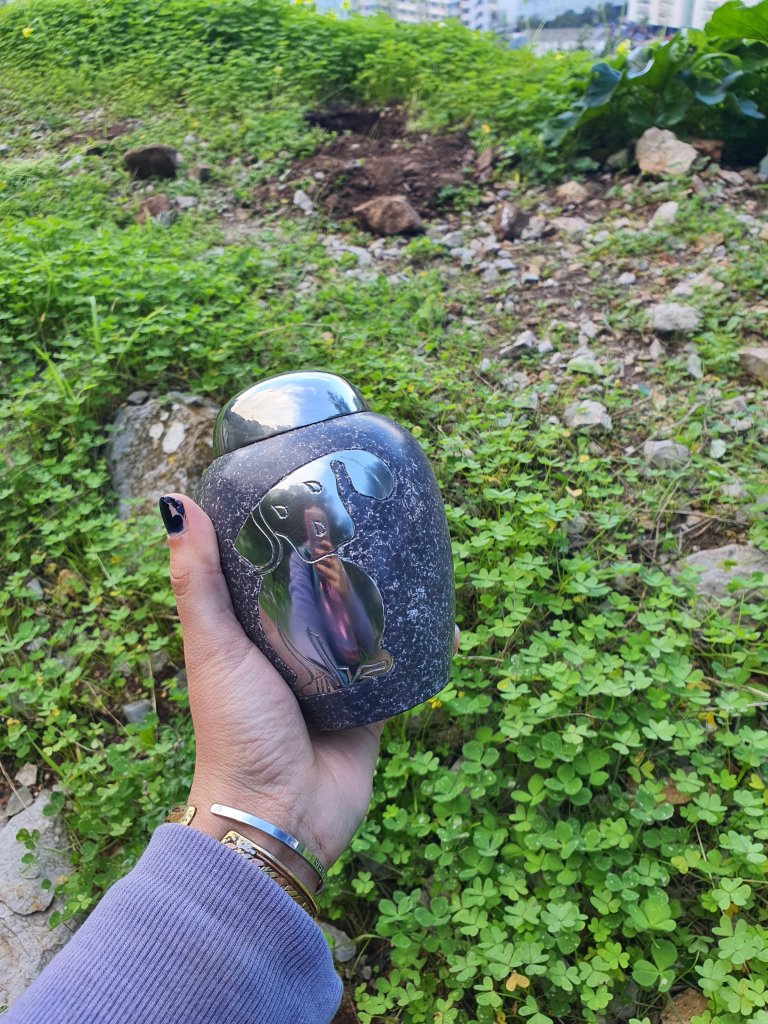
Last year, we spent a few months in Gibraltar living with my parents, and consequently my childhood dog who was 17 years old by that point. Soon after we came back to the UK, my dog (Lucky) died.
I didn’t bat an eyelid. Mum messaged me, and within the same hour I told my kids.
In my view, an hour, or day or week wouldn’t make a difference, except that I’d be lying by omission with absolutely no reason to. I knew it would be sad and hard, and I also knew that they would need the time to process it; so by telling them straight away, I could have my feelings and then be able to hold space for theirs when they came through in full force.
This proved to be an extremely valuabledecision for us, because by the time the big feelings came a week later; I’d been able to light a candle, say a prayer, and celebrate the life and joy my dog had brought. It gave me the mental space to hold them, hear them, and also steer them through their grief. Yes she was a dog, not a person, but she was family, and they felt the impact of her loss deeply.
We had read books on death before, and regularly spoken about the circle of life, and we’d told the kids that Lucky was old in her bones. She slept a lot. Was slow. We knew it was coming.
They loved her. In the short spurts of time they’d spent with her, she left her pawprint in their hearts; especially my oldest who met her for the first time when he was 5 days old. She’s a part of their story, and their first real experience of death and grief.
When it hit them, the kids cried. They asked what would happen. They asked where she’d go. We spoke about different traditions, and how she specifically had been cremated so her ashes would return to the earth and new life would bloom where she was laid. Our favourite book was The Endless Story which is illustrated beautifully.
My parents kept her ashes and when we went back to Gibraltar, we scattered them together. We spoken about the grass and flowers, and how the ashes would seep into the soil, and be a part of the process to create new life. We spoke about how some people (including me) believe in reincarnation.
There were many tears. There was a lot of very audible and visual grief… and I told the kids to let it all out. They could be as sad as they wanted, in whatever way felt right to them.
My daughter collected flowers and cried. My oldest son sobbed and shouted, and said he wished we could be immortal jellyfish so we’d never die. My younger son wasn’t sure… he was too little really. But he was there, and that mattered. My parents and brother were with us of course, and they held my children, shared some fun stories and shared in sorrow too. It was a hard and important day.
That was 6 months ago.
With his recent birthday, P woke up several times in the weeks leading to it, with sobs of not wanting to get old because getting old means we are closer to dying.
Since then, topics of saddness, missing loved ones, wishing nobody would die, worrying that we’ll all get old and die, wanting to be cremated together and various other aspects of death have since become a part of our life. At any given moment, sometimes close together, sometimes with weeks in between, they’ll make a comment, or get quiet, or have a wave of tears about Lucky being dead. A (aged 3) has commented and cried things like “I didn’t want Lucky to die” or “I wish I could stroke Lucky again” … but her process has been straightforward for me, we’ve cuddled, cried, sonerimes shell ask for a story of when Lucky was little or for me to tell her about when she’d help my dad with dog walks, and then that’s it. P (aged 6) on thr other hand, has not been so straightforward; like with pretty nuch everything, his high sensitivity has really shone through.
The way I’ve been managing this has varied; sometimes it’s just a case of listening, reflecting back what he’s said, and then holding him through it. Reminding him that I am here and these feelings are normal. He often will spend a few minutes here in this space and then enter a new conversation with me or say he’s ready to play.
On his birthday, he said when we die, we disappear forever, and so I brought in the concept of memory keeping us alive, and about how people leave their legacy; I specifically said about how people that invent things might live on through their inventions or discoveries, like gravity and electricity, or through movies and stories like Vikings, or through preservation like the dinosaurs. All of those creatures/people might be dead, but we haven’t forgotten them. This worked remarkably well, and he visibly relaxed as he worked out that we fly planes and take pictures and drive cars, even if the people who invented them lived long ago.
Lastly, if it’s a really hard one, or a particularly big feeling, like when P says he wants us to all be immortal jellyfish, or when he tells me that he’s scared he won’t come back and be with the same family, I remind him he can choose what to believe. They there’s no right or wrong, and that nomatter what, we are here now, making the best of it. Usually this also involves cuddles or closeness too, something I’m particularly aware of because I want him to feel safe through the feelings.
Chatting about the grief has open windows of conversation, and we’ve spoken openly about how grown ups come back and that also not always. We’ve spoken about safety first in situations like climbing or jumping or in the car. We’ve spoken about age, and how age isn’t the only factor in death.
Mostly the emphasis is on saying thank you to the earth; for growing more and blooming, and showing us that there really is a circle of life.
When I wrote the title of this piece, I cringed! It’s inspired by the continuous discussion and questions asked of parents, about whether or not their children are good, because they don’t cry a lot.
Good? Really – what makes a good kid? Is there a set criteria? It’s something I’ve been think a lot about recently, and definitely something that carries so much weight and pressure, as adults who were raised with the notion that good is desirable and that anything else would be ‘not enough’. From a generation that was manipulated into behaviours that got us rewards, the notion of a good kid comes with a hefty price.
But bear with me. I don’t actually think that only ‘good’ kids communicate; instead, its about a sense of safety.
If communication is required in some form, to allow meaningful interactions with others around us, then communication, whether through spoken language, body gestures or other forms non-verbal interactions is a cornerstone of our existence. Therefore, it stands that I will assume, communication in ANY form, is the way that kids communicate their needs.
The caveat here, is that when kids are responded to, they continue to communicate – thus falling into the ‘good’ category (i.e. safe); whereas if they are ignored, neglected, or pushed away, these children often learn that their attempts at communication are a waste of energy – and energy is a precious resource.
Good kids, are kids who, despite it being unpalatable for their grown ups, are safe enough to continue their efforts at communication – they are SAFE in the knowledge that at some point they will be responded to. And so they persist.
But still, society asks if our children are good. They are praised for not crying on an airplane journey. They are hushed when they upset on a bus. They are given screens in public places just to avoid embarrassment; and if this isn’t an option and they act up, they are often labelled ‘naughty’ or ‘bad’ or something equally as ridiculous – either by passers by, or by overwhelmed parents who just want to get out of the situation, often being triggered by the fact that we have been conditioned into the unacceptability of these outbursts of noise. We sometimes even hush their joy for the same reason – fearing it will bother people around.
But it is an outdated idea that good kids are quiet. The notion that good children don’t cry, is actually more telling of the society around us, the expectation that kids should be seen and not heard, that kids – despite being so dependent on us – should never cause inconvenience by crying, or communicating that they require something that puts us out.
Not all kids will do this. Some will, in a last ditch attempt to gain the response, acceptance and love they crave; be extra loud, extra hyper, extra – everything; and again this isn’t effective communication, because they haven’t felt safe.
Truly, as we learn more about children, the way they communicate with their voices, their bodies, their cries. The way that they play and process, and the way that they marvel at the world with eyes so bright – all of the time, communicating. The way that we respond matters. Safe kids, will communicate their needs.
Quiet kids, are often quiet because they don’t feel heard, or feel like they shouldn’t be heard. They have internalized that nobody is going to respond; and so make sure to take up as little space as possible – often becoming adults who do the same and cannot set boundaries, honour their needs or even understand why it’s so hard to communicate with peers/others.
So what makes a good kid? Is there a set criteria?
I don’t think so. I think, though it’s hard, the question we should be asking is about those raising them. What makes a good parent? How do we respond to our children to let them know, even if we don’t fully understand what they are telling us, that we value their communication? What do we do, even when we don’t approve, that let’s them know, all communication is valid, all their needs and wants can be heard, even if that means we say no.


 Supporting you from pregnancy to parenting