From the moment of your conception right until the moment you are reading this, you have been absorbing and filtering information. You’re doing it right now too. Every second of every single day.
It’s actually really fucking amazing – and, it means, we have a LOT of conditioning to work through whenever we try to break a cycle or move through some shit.
In terms of birth, what does this mean? We’re not constantly thinking about birth (unless you work in the field) or about how babies come into the world. We don’t actively consider the sacred period of postpartum days. We don’t consciously create a negative or traumatic birth. Why would we?
And yet, the percentage of women who experience birth trauma is rising. It is scary and getting scarier. The maternity services in this country (the UK) are deeply overwhelmed, understaffed, and failing. Arguably this is because of funding and politics and a lack of knowledge etc etc. However, I’ll go a step in a different direction here and say it’s also because we are so deeply conditioned in this society to think about birth a medical problem, a painful experience, and something that we have to survive.
We are conditioned from the moment our parents find out we exist; their thoughts and fears and joys about our birth will transmit information to us, in utero, about what birth is like. Then, our actual entrance into this world either confirms these beliefs that have begun to form, or it challenges them. Either way, beliefs are created- often in the last few generations they were not positive ones.
It might sound a little weird but if you get it, you really do get it. These imprints are the first of many foundational layers of our whole belief system. Every single second. Every single day. It’s all absorbed and filtered.
So then, we hear about birth, we hear screams of labour on the tv, or family and friends talking about the pain and trauma. We grow up with messages that birth isn’t beautiful, that it is bloody and breaks us, and so we fear it.
Generations have birthed under the controlled “guidance” of professionals reinforcing these views that birth isn’t safe or joyful or sacred.
Granted there are exceptions, and someone will say that it’s “not all” but it doesn’t have to be all. It’s some. It’s a majority. And if you have any other racial or economic cards stacked against you, its even more.
Like I said earlier, we don’t consciously create a negative or traumatic birth. However we often do consciously create (also referred to as manifesting) a positive birth experience. How? By filtering out the noise. By deconditioning our expectations of birth.
There are some radical revolutionaries out here doing this work. Deconditioning birth and postpartum, and inviting as many families as we can do the same. Those of us who have seen, heard and sometimes even felt the trauma that can be associated with birthing babies into this world; taking our experience and expertise and molding it into something we share. We are here, and we want better for our collective decendants.
We are here breaking the cycle. Saying no more, doing this sacred work of holding these spaces. Saying enough. Saying the conditioning stops here.
I invite you, regardless of where you are in the experience of birth – having had babies or wanting them, not interested in kids or somewhere in between – what are your beliefs about birth? Where have you been conditioned and where have you consciously created these views?
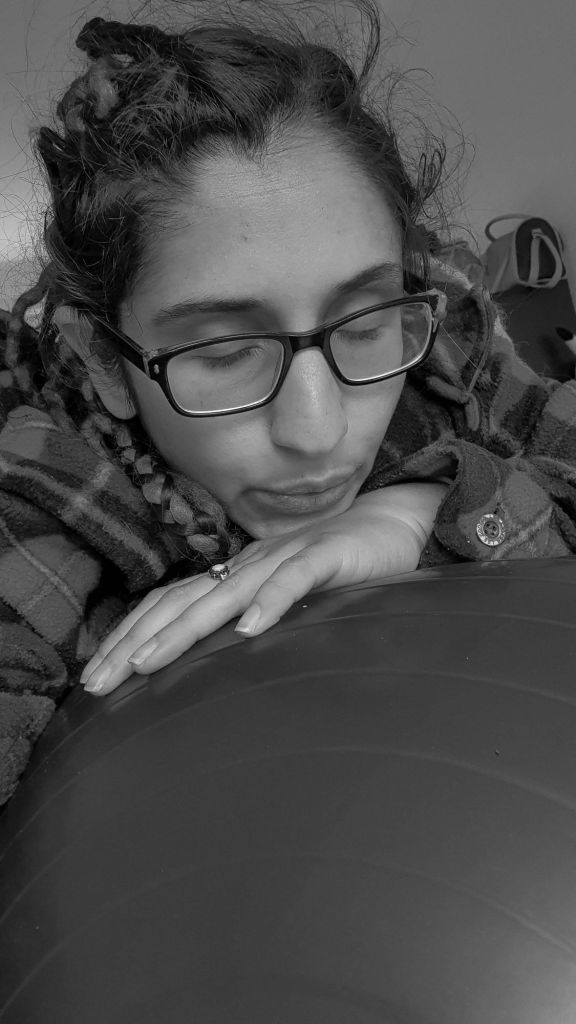
It’s been a month, just over actually, since S arrived in our world. A whirlwind pregnancy, and a whirlwind birth, and I say that in the most loving way.
After writing for 40 days, I took a break, and dove deeper into my journals, moved from Plymouth to Scotland and tended to not only my nervous system, but my children’s too – moving really is such a rollercoaster.
2 weeks exactly after we moved into our new space, S arrived… in a glorious, entirely uninterrupted freebirth, with his older siblings witnessing the pain and joy and nearly everything in between.
My early labour started on the Sunday night, the contractions starting off, noticable enough, and also nothing to make me rush. Though I had been joking about how this would be a fast birth, especially when I was stressing about our move, actually, this was the slowest one of all of them.
I slept and Monday morning it was as though nothing had happened. I took the kids up to a play group while H ran errands and walked back home, stopping at various playparks along the way. I rested in the sun, and made peace with the idea that I could still be housing my baby for another few weeks. Of course, that wasn’t the case, but looking back, I think in accepting that there could be weeks of pregnancy still to come, I was able to let go of (at least that part of) the control and wondering that was coming up.
Monday night was the same, and then Tuesday morning, about 5am things started moving faster. Contractions would wake me up, and I was breathing and moaning through them… I said to H, if this kept up we could have a baby before lunch. Alas, it would be another whole day and more.
Things tappered off after breakfast. I cancelled plans and built my bubble… texting a friend who we’d planned as a second birth partner/my emergency contact… she said she would be coming round later if I wanted her to, and so, before midnight she arrived.
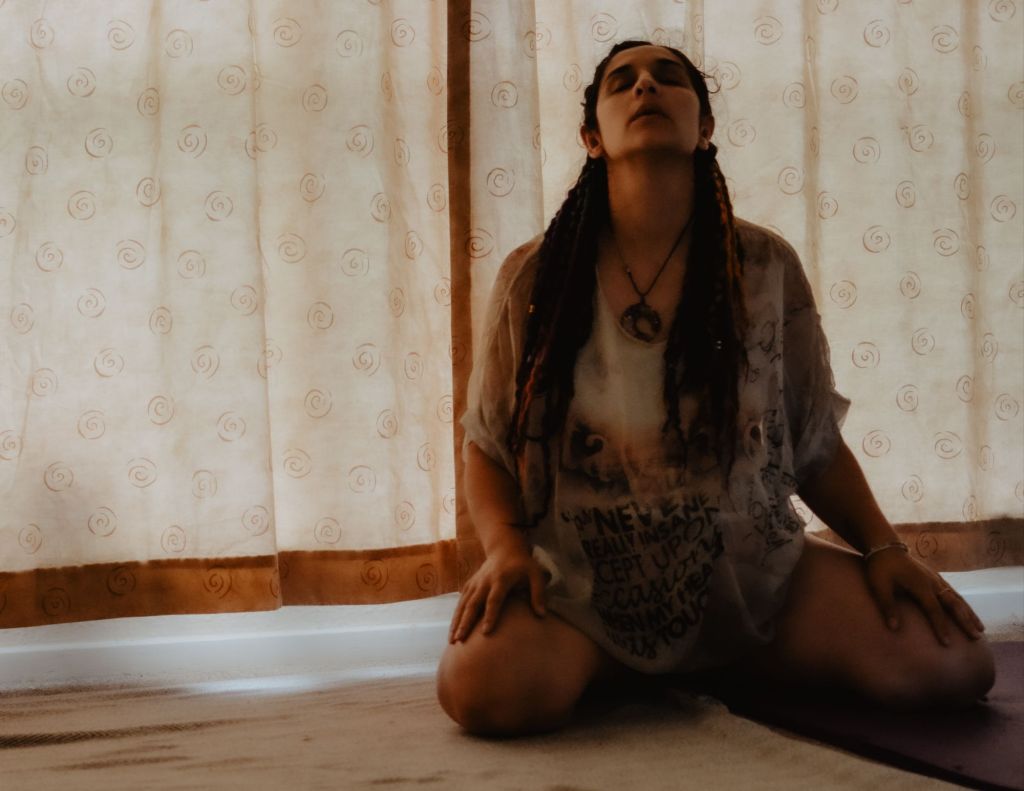
Through the day, I swayed through contractions, talked to the kids about how baby was working hard and getting ready, and told them even though it might sound scary, mummy was actually really okay. We played and took photos, I had intended to capture more of the birth story but once it was happening, I didn’t want to be thinking about lights and camera settings… so there are only some beautiful snippets from the early hours.
I cooked dhal and made mango cake with the kids, knowing that in the days ahead, I’d appreciate the nourishing food and sweet treat immensely. The day rocked between restful and restless, I was anticipating contractions and refused to time them, but could sense there was no regularity. They got stronger, and then further apart, and given what had happened with Ks birth, I knew that could mean that baby just wasn’t ready yet.
Bedtime took its toll, I was physically and mentally exhausted and also knew we still had a long marathon to go. My friend was on her way, and while I took the kids to bed, for the last time as just the 3 of them, H put the pool up and eventually they all went to sleep. As they did, I felt peaceful, tired and wondered how the next few hours would go, given that bedtime had once again slowed everything down as I focused on being mum, and turned away from the internal pull to go deep into labour.
My friend arrived, and we sat and spoke a while, H and her sharing stories, me listening in. The oxytocin growing and the support felt immensely. I asked H to fill the pool.
Pool filled, I got in, and the relief was pretty instant. In previous births, water has been a huge part of managing for me, and this was no different. The water makes things easier, and I needed it. Water however, slows earlier labour down, and though I was frustrated that this happened at the time, it also provided the much needed space to rest. I slept in the pool for hours, and it was in this sleepy limbo state where I met my baby, I spoke to him, and he told me to trust him, he was trying and he wasn’t ready yet. It was here, where all the confusion about names melted away, because as we spoke, I called him his name, and afterwards, I knew we couldn’t choose anything else. He had chosen it there, in those moments in the pool.
I got out the pool in the early hours and danced. I shared some moments of reset with my husband when he checked on me, and journalled my fears, and then, as the dance of labour continued, I put in my earphones and did a breathwork session, setting intentions and adjusting my expectations. I needed to stop trying to fonr the pattern or match this experience to thr ones before, I needed to let S create his own story. It was about 5am when I fell asleep again.
A few hours later I was talking to E, my friend who had come and stayed over and slept on a mattress on the floor, I told her about my realisation moments, and in true E fashion, she asked what I felt I needed to be supported and nurtured at the time. I love her, and this question really unlocked something for me.
She had some breakfast, walked our pup so H could rest, and then got ready for work. H took her and P & A in the car, dropped her off and went to grab eztra snacks for the kids. I stayed home with K while he watched paw patrol so I could nap… we had joked that as soon as she left, things would quicken. They did.
E had helped me put the TENS machine on earlier, and though contractions were still irregular, I was going deeper. I napped and a while later called H and told him I needed him and to come home without snacks if need be. He asked if I’d had the baby already, but I was still hours away, I just wanted my person. Though I didn’t want to be touched or held, I wanted him around, because he helped me feel safe – in those moments I was seeking safety and solitude.
I knew I could do it alone. I didn’t want to.
He got home and I was deeply in my zone by then. I came half out of it with the kids, who were so excited, and then, I got in the pool while he played with them, fed them and they watched TV. They wanted to be involved, and so i taught them about breathing with me, and how the sounds mummy was making weren’t bad, because though it hurt, it meant my body and baby was doing exactly what they needed, and it was helping him come out. There are some videos of these moments, I asked H to take because I couldn’t, and the other day, I heard A watching one as she scrolled through my camera roll. She says it reminds her of that day and that it sounded scary but wasn’t bad.
After a while, I wanted space, so they were upstairs, I was down in the pool. I wanted H near, and I also wanted to be alone… so I could feel him close but he knew not to touch me. The kids shuffled arould curious, playing and checking on me.
I knew they were moving around, but it felt so normal and safe… mostly anyway. I remember at one point they were all shouting and I told them to be quieter… when they didn’t, I told them they weren’t helping baby come. Then they started breathing with me instead, and though it meant I was focusing on them more than my body, it was both funny and wholesome.
Then, as they were upstairs and I was down, I felt S start to decent. “He’s coming” I said…. and then, I stopped “get A”.
H ran to get the kids, and they came down, watching and waiting. It was nearly an hour later before he arrived, so H moved the laptop to the kitchen and they watched there quietly, knowing it was soon.
That last hour or so was hard. I remember telling H I was dying. He told me I wasn’t, and I told him to shut up because I absolutely was. I told him I couldn’t do it. I felt like I was breaking… I was scared and also, there was a part of me listening in, knowing that because this was where I was, I was at the very end of the marathon now. I heard myself say I could do it and H said “you can, you can, you can” … something we say to the kids.
The next few surges, I held this mantra with me. I can. I can. I can.
And then, I said he was coming – my body took over and I fully became the portal allowing him to enter. H grabbed my phone and video, told the kids to stand by the pool and waited. “He’s here” is the start of the video, the biggest relief and quiet accomplishment palpable in my voice.
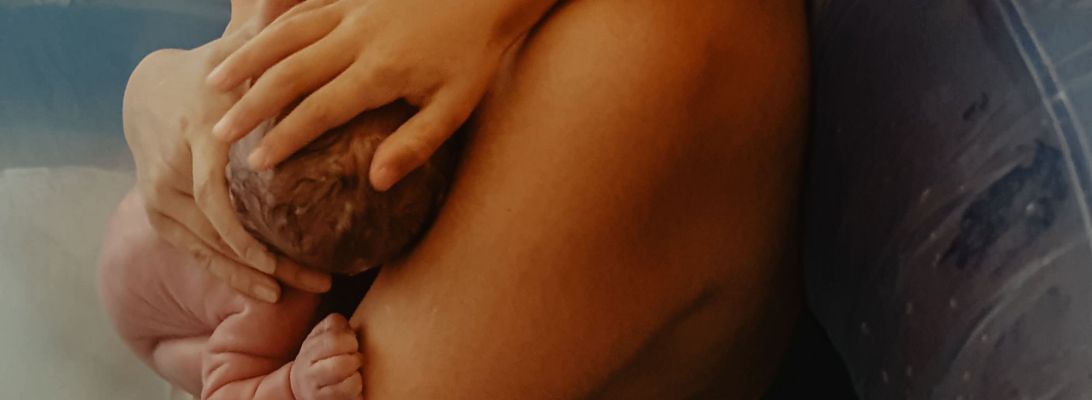
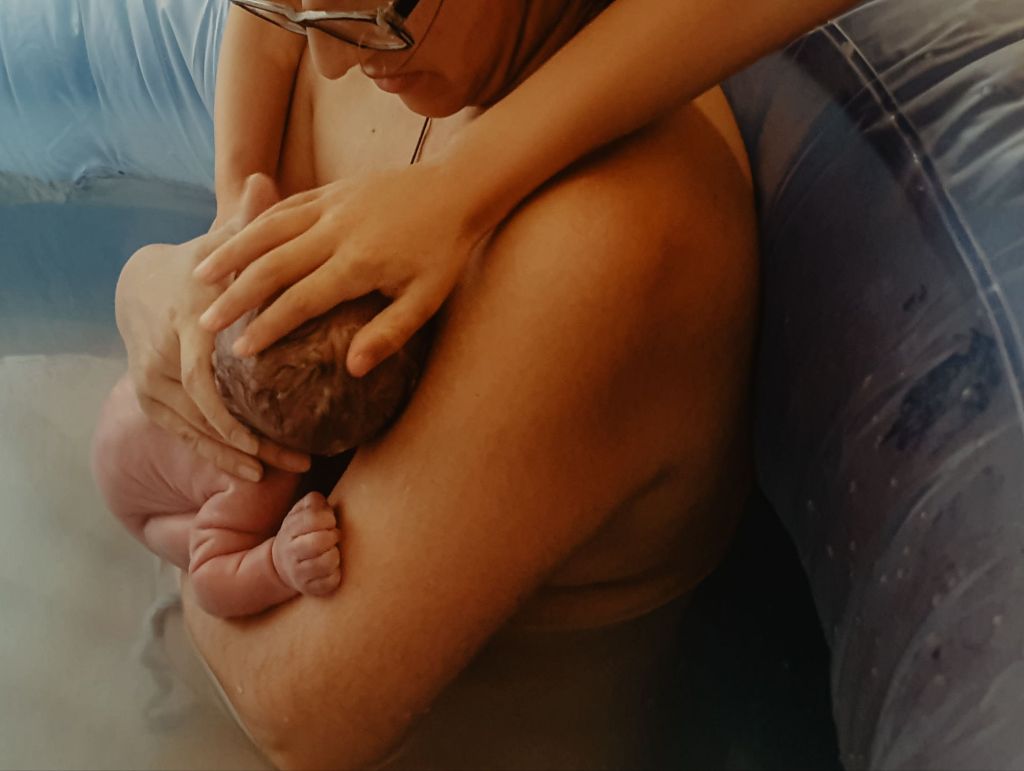
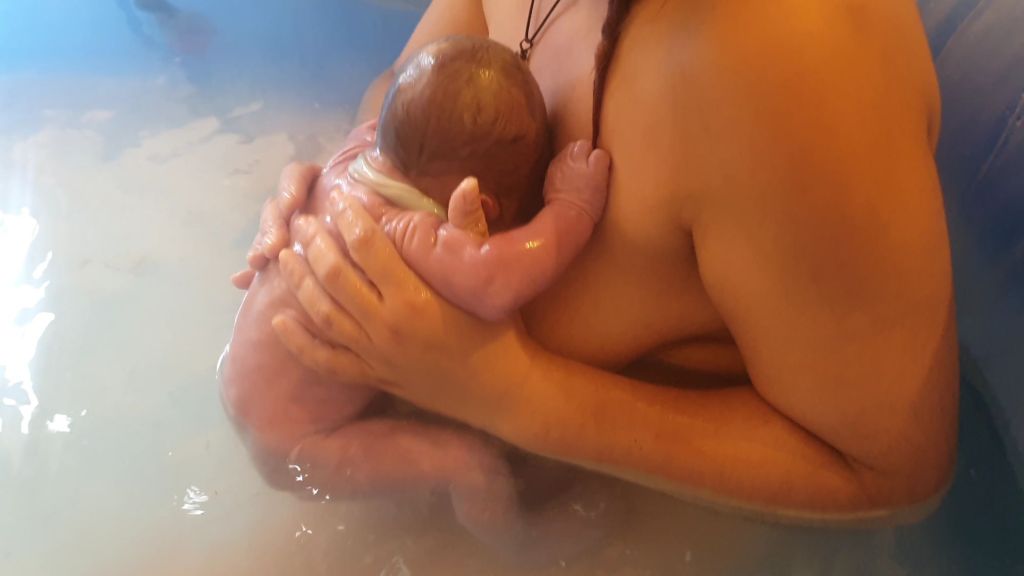
S arrived completely of his own accord. I didn’t push. Foetal ejection reflex happened, and he entered into the world in the pool, the calmest, most beautiful experience, exactly what I had hoped for, except better. The video is one I will treasure forever.
As soon as he was here, I brought him out the water and the kids wanted to meet him, so I invited them into the pool, reminded them he was still attached to the placenta and they touched his head, saying hi. K said “it’s a baby kid” which when I listen back sounds like either pink or pig, but H understood he was saying S had arrived.
The pool started turning red; the kids got out and I followed. We knew from our experience with K that the placenta could be very quick, but just to be cautious, I had some tincture that I’d bought specifically. Within 10 minutes of his birth, squatting over a bowl, the tiny placenta that had been the life force of S while he grew was out, and though again we were cautious to watch the bleeding, after those initial few minutes, aside from the intense nausea, I was feeling so good.
It was post birth that I started actually being sick, my bodies reaction to the intense marathon it had just completed. H fed me, and made sure I was hydrated… but for a few hours, nothing stayed down. We called the midwifery team after the placenta arrived, and they sent someone out. She was honestly lovely, kind, excited to be coming out to a freebirth, and so congratulatory through the whole thing. I had been worried about calling anyone but she made the whole experience feel so easy, she notifed our birth and checked with us every step of the way.
A few hours later, once we’d told families and friends about our new addition, it was bedtime, and so the kids all chambered into bed and said goodnight to their new baby brother. The weeks following have been a beautiful rollercoaster… the most healing postpartum I’ve had. The most restful. The most active in many ways too. It’s been such a different experience… I wish I could bottle parts of it up to gift away. Between the mini meal train organised by E, and trip my mum did (flying from Gibraltar!) to see us and cook so I could rest, and the beds on the floor downstairs that helped H insist I rest, and the 12 days at home while others came to me or went out, I have really felt that there is no “right” way to do postpartum, but that there is so much that can aid us if we lean in. An
Anyway, there it is, the birth story of S. I could have written more… but its already 2000 words long, and I’ve lost many details already honestly. Like with everything, this is my version, this is my experience, and it is what I can remember… but truly words don’t give me the real way to describe this story. Alas, it was far more than these letter combinations can convey.
I’ll write again soon (ish),
With love, Rohana x
Would you like to share your birth story? Do you have questions? Get in touch and let’s chat.
The experience of welcoming a new human earthside is a remarkable journey. I’ve done it 3 times… and the feeling I get when I share my experiences, and listen to others is incredible. There is something so sacred about birth.
However, though absolutely deserving of the attention it gets; birth is the highlight in media and many conversations; with postpartum being a little left on the wayside. For first time parents, there is some emphasis placed on the changes of this transitional period (though by no means enough); but after that, it kind of just dissapears into the noise of everything.
Postpartum is just as – if not more – sacred that birth.
As I prepare to deliver a session next month on the postpartum period to some wonderful Doulas in training, I am called to write about it here too. In part, this is because, through the whole rollercoaster of parenthood, the attention, support and social associations between male and female parents is so different. I honestly cannot speak from stories of same sex couples; because to date I only know 2 same sex parent families who’ve had children, both of whom are female identifying. That said, we’ve all seen the memes where mum goes to the shops and is expected to ‘control the toddler’ versus dad who is ‘so wonderful’ for literally being a parent.
Nonetheless, outside of social expectations, speaking to men about their experiences postpartum – it is just as lonely, if not more so for them. It is isolating. It is hard. They receive even less support, with many (much needed) services aiming to support mothers as they transition into motherhood, and few doing the same for fathers.
Yet, it is, in my opinion, vital to recognise, support and celebrate the role that fathers play in the postpartum period. Supporting families as a whole unit here, in these early months, can lay the foundations for a family life that is built on a strong sense of connection, trust and nurturing. Not only is the child or children in a far more stable, healthy environment for their emotional growth, but both parents are more likely to communicate kindly with each other, have compassion, and connect in a more intimate way – which, let’s be honest, isn’t going to harm anyone’s sex life.
How can we support families as a whole unit?
In my postpartum prep session I dive deeply into conversations about the 4th Trimester and ways we can really support families.
If I could gift any new parent something, it would be this support. A step towards that is this information.
Nourishing the Body with Good Food:
One of the most fundamental ways to provide support is by ensuring that postpartum families are nourished with good food. In the absence of being able to literally take someone food (because honestly thats a BIG task), recommending recipies or supporting them to create a meal train where friends/famkly bring food, can make a huge impact.
The demands of parenting, combined with sleep deprivation and physical recovery from labour and birth, will massively affect new parent’s energy levels. Fathers, in particular, often are expected to step up to ensure that the family is well-fed during this vital period – and a sense of support and direction is helpful.
Nutrient-rich meals not only aid in physical recovery but will contribute to state of mind. When both parents are nourished with wholesome, healthy foods, they are less likely to falter in moments of stress, because they are physically having this need met.
Rest
In a fast-paced world, the idea of rest that isn’t justified by some kind of productivity beforehand might seem elusive. However, the fourth trimester calls for a major shift in perspective, where rest is acknowledged as a precious commodity. This is as true for fathers, who at least in this country are required to go back to their day jobs only 2 weeks after baby arrives, while still adjusting to their role as supporting the family in this new way.
Many conversations centre how fathers can take on more responsibilities. In part, yes I agree, because nursing a baby is a full time job and mums need rest. But, radically, I also assert that fathers should prioritise rest.
This should absolutely be a conversation before baby arrives. Dishes can be minimalised. Hoovering doesn’t have to be as often as it was. The house will be a mess and that’s okay. When dad’s rest is prioritised alongside mum’s, there is more balance, more opportunities for meaningful conversation and more joy.
Mental health
The last big focus in creating a supported postpartum experience, without diving into the other (essential) aspects mental health.
Yeah that’s too vague Rohana … we all know mental health matters, but how do we do anything about it?
Chat openly and honestly. Before having baby and after. Every step of the way… honest, non-judgemental conversations are essential. This is probably best done when everyone has been fed, and there isn’t insane levels of sleep deprivation being used as competitive advantage in the who feels worse game. But seriously, taking to partners about the JOYS and the things that are hard, makes a difference.
Divide and Conquer. Divide jobs/tasks. Remove everything that isn’t essential to be done by you/your partner. Delegates the none essentials. Easier said than done… I’m banking on the idea that you’ve got a gorgeous groups of family and friends who want to help (and can) OR a wonderful doula. If neither applies (it didn’t for me!), then lower the bar massively. Do the essentials. Survive. This isn’t forever.
Find friends. Groups. Peanut. Facebook local groups. Whatever is an option… if you can, use it. Parenting is isolating, and by having someone to give and receive some solidarity around, it helps. *careful not to just find ranting buddies who keep you feeling low*
Lastly, do things for joy. Don’t give up hobbies. Don’t ask your partner to. In fact, schedule them in with extra vigilance, because being reminded that you’re a human outside of helping this tiny person grow and survive is really important.
There’s so much more to say… creating a supported, wholesome postpartum and beyond experience isn’t going to magically happen. It is worth the work though, because when you are supported, you feel safe.
When you feel safe, your nervous system capacity can hold more.
When you feel safe, baby (and other children) feel safe too. Their mirror neurons mimic your regulated state.
Then, the cycle of safety, support, joy repeats. It cycles. And grows.
This time for growth and unity as a famkly builds the sturdy foundations of trust and connection, which, when toddler and teenage years come by, will be something that holds everyone through.





 Supporting you from pregnancy to parenting