Grief: The Death of our Dog

Talking to kids about grief is a big topic, and it’s often one that many parents find hard. Most adults steer conversations away from grief, or are awkward when it comes up. So talking to children is even harder.

And it’s even more important.

These are my reflections of our experience of losing my parents dog, how it’s impacted my children and how it’s opened windows into conversations that we’d have otherwise probably not have had.

Last year, we spent a few months in Gibraltar living with my parents, and consequently my childhood dog who was 17 years old by that point. Soon after we came back to the UK, my dog (Lucky) died.

I didn’t bat an eyelid. Mum messaged me, and within the same hour I told my kids.

In my view, an hour, or day or week wouldn’t make a difference, except that I’d be lying by omission with absolutely no reason to. I knew it would be sad and hard, and I also knew that they would need the time to process it; so by telling them straight away, I could have my feelings and then be able to hold space for theirs when they came through in full force.

This proved to be an extremely valuable decision for us, because by the time the big feelings came a week later; I’d been able to light a candle, say a prayer, and celebrate the life and joy my dog had brought. It gave me the mental space to hold them, hear them, and also steer them through their grief. Yes she was a dog, not a person, but she was family, and they felt the impact of her loss deeply.

We had read books on death before, and regularly spoken about the circle of life, and we’d told the kids that Lucky was old in her bones. She slept a lot. Was slow. We knew it was coming.

They loved her. In the short spurts of time they’d spent with her, she left her pawprint in their hearts; especially my oldest who met her for the first time when he was 5 days old. She’s a part of their story, and their first real experience of death and grief.

When it hit them, the kids cried. They asked what would happen. They asked where she’d go. We spoke about different traditions, and how she specifically had been cremated so her ashes would return to the earth and new life would bloom where she was laid. Our favourite book was The Endless Story which is illustrated beautifully.

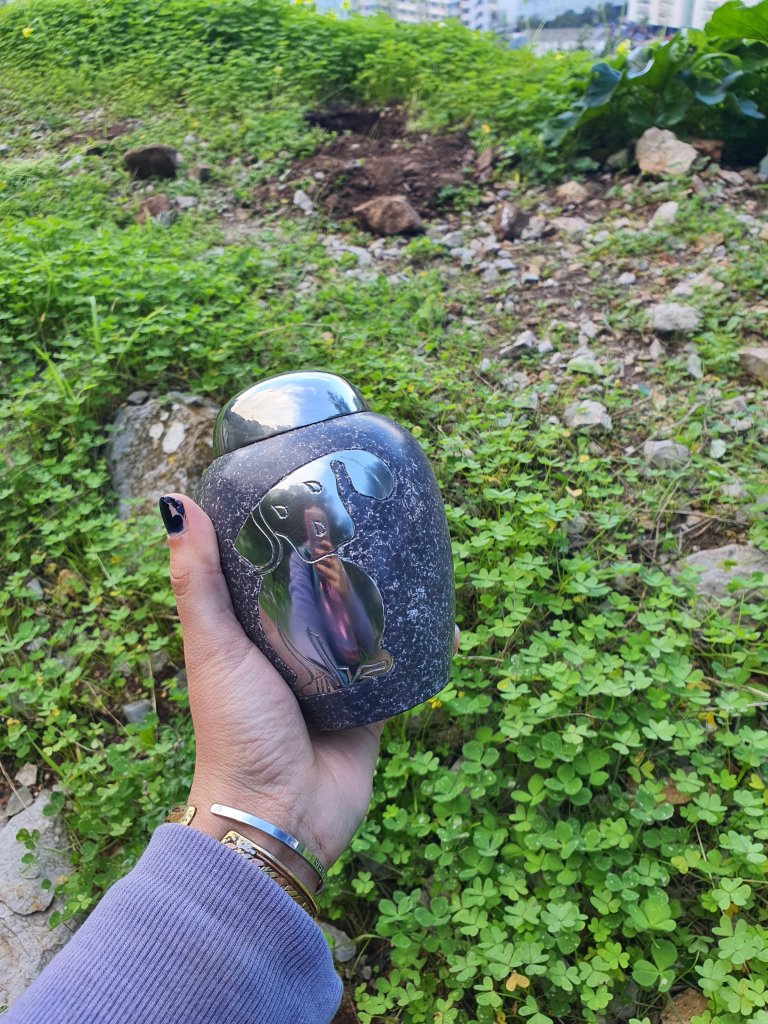
My parents kept her ashes and when we went back to Gibraltar, we scattered them together. We spoken about the grass and flowers, and how the ashes would seep into the soil, and be a part of the process to create new life. We spoke about how some people (including me) believe in reincarnation.

There were many tears. There was a lot of very audible and visual grief… and I told the kids to let it all out. They could be as sad as they wanted, in whatever way felt right to them.

My daughter collected flowers and cried. My oldest son sobbed and shouted, and said he wished we could be immortal jellyfish so we’d never die. My younger son wasn’t sure… he was too little really. But he was there, and that mattered. My parents and brother were with us of course, and they held my children, shared some fun stories and shared in sorrow too. It was a hard and important day.

That was 6 months ago.

With his recent birthday, P woke up several times in the weeks leading to it, with sobs of not wanting to get old because getting old means we are closer to dying.

Since then, topics of saddness, missing loved ones, wishing nobody would die, worrying that we’ll all get old and die, wanting to be cremated together and various other aspects of death have since become a part of our life. At any given moment, sometimes close together, sometimes with weeks in between, they’ll make a comment, or get quiet, or have a wave of tears about Lucky being dead. A (aged 3) has commented and cried things like “I didn’t want Lucky to die” or “I wish I could stroke Lucky again” … but her process has been straightforward for me, we’ve cuddled, cried, sonerimes shell ask for a story of when Lucky was little or for me to tell her about when she’d help my dad with dog walks, and then that’s it. P (aged 6) on thr other hand, has not been so straightforward; like with pretty nuch everything, his high sensitivity has really shone through.

The way I’ve been managing this has varied; sometimes it’s just a case of listening, reflecting back what he’s said, and then holding him through it. Reminding him that I am here and these feelings are normal. He often will spend a few minutes here in this space and then enter a new conversation with me or say he’s ready to play.

On his birthday, he said when we die, we disappear forever, and so I brought in the concept of memory keeping us alive, and about how people leave their legacy; I specifically said about how people that invent things might live on through their inventions or discoveries, like gravity and electricity, or through movies and stories like Vikings, or through preservation like the dinosaurs. All of those creatures/people might be dead, but we haven’t forgotten them. This worked remarkably well, and he visibly relaxed as he worked out that we fly planes and take pictures and drive cars, even if the people who invented them lived long ago.

Lastly, if it’s a really hard one, or a particularly big feeling, like when P says he wants us to all be immortal jellyfish, or when he tells me that he’s scared he won’t come back and be with the same family, I remind him he can choose what to believe. They there’s no right or wrong, and that nomatter what, we are here now, making the best of it. Usually this also involves cuddles or closeness too, something I’m particularly aware of because I want him to feel safe through the feelings.
Chatting about the grief has open windows of conversation, and we’ve spoken openly about how grown ups come back and that also not always. We’ve spoken about safety first in situations like climbing or jumping or in the car. We’ve spoken about age, and how age isn’t the only factor in death.

Mostly the emphasis is on saying thank you to the earth; for growing more and blooming, and showing us that there really is a circle of life.

As ever,

Thanks for reading xx

Rohana
Little voices, Anger and our brilliant brains

You know when they’re little, they say some things but it sounds a little funny because they can’t quite pronounce it yet. Then suddenly, that little difference stops, and we wonder when they learnt to say words the way we do. Every time I hear my littlest talk at the moment, I want to record it all because I want to bottle it up and preserve the sweet accents and voices he does. Of course, that defeats the purpose of being in the moment and actually listening, but I have snuck in a few videos to send family and save as reminders.

I know that these years are fleeting, even when they feel busy. As we approach birthdays, where K will be 2 and P will be 6, I am reflecting on the way they have changed and the language they use. I don’t even remember when it became possible to have such grown up conversations with P, but he’s chatting away nine to the dozen daily, always with a new idea, explanation or request to build something in play. Today we’ve been playing Archelon nests and Ovoraptor mums and I’m struck by how this has become such a norm for us.

P delights in telling me everything about anything; and some of the most interesting conversations happen while he’s chatting away after bedtime, or when we’re out and I can lend him an ear a little more readily as we walk along. He doesn’t get words in as often as he’d like because I’m pulled between all 3 kids, and I can see that it’s having an impact; so when we’re out and he tells me about life and stories, I savour as much of it as I can.

A on the other hand, doesn’t wait for opportunity, she will talk and talk and talk, and has been for years. She really enjoys watching videos on my phone that I’ve taken of them over the years, and sometimes will tell me there’s a specific one I need to see. It gives me the chance to relive some of the best moments, and reminds me why I capture so much when I can; because they change and it feels like forever but also too soon. Hearing her talk on these videos brings to light just how early she’s articulated and narrated her life; and I do sometimes joke that we must have blanked out some months during the pandemic lockdowns because she feels far more grown up.

That said, though I watch my children and marvel at the way they act for their years, I also know they are very much this way because they’ve been given the freedom to grow their voices, challenge us, and come back to safety. I didn’t start parenting thinking this would be the way we parent our kids, but as the years go by, I am more convinced that it’s working well for us. A mix of ideas, lots of trying things out and lots of changes to empower the humans we’re growing with.

A couple days ago, I asked P to stop swinging and hitting the wall with his feet. A little while later, he got upset with his sister and went to throw a punch. We sat down, he screamed at me and told me he had to go hurt her because she started it. So I said “I get it, you’re so mad right now, your hands won’t even let you stop being angry” and then I showed him how when we clench our fits ready to punch, our body and brain message each other to be angry. Alternatively, when we hold our palms flat, open towards the sky/ceiling, our body and brain send messages of calm.

Fascinated, but still upset with his sister; we turned it into a game where he would do something he knew wasn’t allowed – in this case hit the wall as he swung, and I would be “super, extra anrgy mummy” making a fist, stomping my feet and growling before chasing him until he turned around and opened my palms up to the sky and I’d sigh and relax.

We soon had A involved too and they giggled and giggled at the game; which from my reading about playful parenting, I absolutely took as a good sign on emotional release.

I not only marveled later about this snippet of our day from an emotional regulation perspective, but also through the lens of their little voices. I don’t have the urge to video record everything anymore with P, because he’s chats are so different, but I will bring out the dictaphone we bought to record stories with him; and a while back when he was interested and asked me to, we recorded some stories on a podcast for them to listen to. It’s hardly used, and there are about 4 or 5 I haven’t got round to uploaded yet because the interest was lost; but if they want to pick it up, we can. I loved recording them with him, especially where he’d say the words too, because it really felt like a moment of his voice frozen in a beautiful way. I’ve also used it to record stories for our Yoto player, and that’s been fantastic because they absolutely love listening to library books we’ve borrowed and returned, but preserved for when they are in the mood.

Speaking of our Yoto player, P gave me a quick lesson about how our lungs have trees called alveoli and about how the skin is actually our largest organ. He loves lying down with the player and going through the cards when I am busy with his siblings.

His sister on the other hand isn’t fully into audiobooks, but I have often walked into her reading to herself or chatting away about something in a book, to whom I presume are imaginary friends around her. Her chats are so different to his, and while he tells me how things work, she tells me how beautiful life is. She’ll tell me she loves things, the colours, the shapes, the sounds. She’ll ask to play games with me and then get bored, go find P and I hear them playing a version of things they’ve watched on TV, chatting away and planning roles. It’s the best sound, and one, I really never imagined we’d get to when they would fight all the time.

Home educating them has meant we focus a lot on conflict resolution though, and I can see my attempts and explaining energy and actions are starting to show. I can see how, even though I’ll have to call out “sort it out guys” or step in like with the punching scenario above; they are also learning how to work together. They call themselves a team, and P will say our team has 5 people, but because daddy’s away, it’s got 4 right now until he’s back. It’s a wonderful thing to hear for me, because even though I know it’s his coping mechanism and sounds a little sad, it’s also a beautiful one, and healthier than others from the past. I can see the growth, and importantly, I am learning more deeply that while I have influence over my children as their parent, I cannot control the way they react to situations but I absolutely can do my own inner work and co-regulate with them to build resilience as they get older.

This month has been a rollercoaster, in the same way that many months have been, with changes of direction and disconnection while we each find out feet figuring out what we need. I’m leaning into screen time as a tool for productivity but also for connection; joining them in their joy while they show me what they can do on a game, or chatting with them about the episodes they watch. I’m adapting so that they can have moments of time with me, which had been few and far between since their dad left in April, and I am factoring in, for the first time in years a 20 minute yoga practice that even if it’s midnight, I will make time for.

I tell my kids about their playdough brain; reminding them they can grow their brain and expand their capacity regularly. In doing this, I guess I’ve also been giving myself room to expand my own capacity too; slowly integrating the future I want to manifest for them from a cognitive ideal, to an experience. I have spent years focusing on making sure they know about their brilliant brains, and in doing so, I’m seeing this month how my own brain is brilliant too (and as a reminder to you reading this, yours is brilliant as well).

Wishing you a beautiful day, week and month ahead.

With love,

Rohana x

Why did they burn girls mummy ?

International Women’s Day brings lots of feelings up.

Last year, a school friend of mine birthed her gorgeous baby into the world; and though we’ve never gone deep into the story of her birth, I know beyond words she was phenomenal. This year, it was one of my first thoughts – her baby turned 1. What an absolute honour to know women raising women, strong, capable, loved.

What an honour to be surrounded by women, breaking cycles, healing themselves, and birthing their own girls into a world with less to carry forward.

I thought of my friend and her baby. I thought of my own pregnancy and how much carrying a girl forced me to confront fears about raising one.

I thought about how raising a girl has changed me; pushed me to advocate for myself, and to heal – so that she (and my boys) have less to work through; less to weigh them down, and less to pass on again.

I looked at my daughter; awake and asking for breakfast and I thought, today is going to be a good one.

We played and chat, and her brothers woke up; each in their own little world.

I watched her write and thought about International Women’s Day, and what it means to me, and what it might mean to us as a family unit. Should I mark the occasion? I had nothing prepared.

In the end, we didn’t celebrate specifically. We didn’t do any special crafts or read anything because of the day; which I have tried in previous years and have learned, as I dive deeper into the knowing of myself as a mother, that these things (though joyful and purposeful in part) bring stress and discomfort to our group. Instead, we talked; about bodies and women, and how we are most powerful when we can do both what we want, and what is right for the world.

Well behaved women rarely make history

Eleanor Roosevelt

The other day, she asked me about my current read; Burning Woman by Lucy H Pearce, and together with Theo, we spoke about how women (and men in smaller numbers) were burned for magick. They were horrified, without any extra detail – but they asked for more.

Why?

What could I tell them? At ages 5 and 3, how could I explain the privilege they sit on, through the place they live in the world, the tonality of their skin, the reality of job security that their dad has, and the choices we make as a family – they are so damn lucky. And they know it, in part; but at the ages of 5 and 3, I am not going to burden them with the weight of it being so vastly different for so many.

That said, I won’t shy from it either.

Instead, I told them, that the people in power (a little like in Frozen II with Elsa’s grandfather) were – and are – scared of magick. They feared people who knew nature, and who could find food and medicine in plants. They were scared of women who didn’t listen to them, because they wanted to be in charge; and when they weren’t listened to, they got angry. When they couldn’t control the magick people, they decided to call them witches; and hunt and burn them.

But why did they not listen mummy? Why did they want to control them? Who was in charge?

“They didn’t listen because they didn’t want to – a little like when you don’t want to stop playing for dinner; you don’t until you’re ready, and I can’t make you. The difference is, in our family, we respect your bodies, and we try and listen to what you want and need as much as we can. It hasn’t always been like that – and it still isn’t for everyone. Every family has it’s own rules – but now, we don’t burn people for not listening.”

“They wanted to control them because … well why do you think?” – “To be super powerful… like the baddies do, except, were there any superheroes to come save the people?”

Breathe… my 5 year old got me. He may push my limits but he just gets things, and says them in ways that make me need to hit pause.

We carried on talking… about baddies and superheroes, and how in real life it isn’t so simple. Again referencing things they understand; like the Bluey episode where Bandit pretends to be the best in the world, and then admits he’s good at some stuff, not everything. We aren’t bad or good all the time; like when we get angry and hit a sibling, it doesn’t mean we are baddies forever, but it does mean we need to repair.

By the end of our walk and talk; they had a basic idea that people were burned because they weren’t understood; and because the people in charge (who are kind of a mystery and “shouldn’t get to decide for everyone”) were scared of them. It wasn’t something I’d anticipated, so navigating it like this felt enough without too much.

I’m glad we’ve begun to raise our daughters more like our sons, but it will never work until we raise out sons more like our daughters.

Gloria Steinem

Today, I didn’t bring up the burning woman conversation from last week. I could have to anchor in points but I don’t think I need to, they’ll show me what they remember and need in time. We settled on talking about how we can support girls and women to listen to our bodies by doing it ourselves and making healthy choices – and about consent and body boundaries for everyone. We chat about how when we do what we want, but that is also right / good for the world, we are celebrating people, and the earth.

And we talked about how boys and men need support to; but that sometimes they need it for different reasons – so they have a different celebration day.

It’s a day that is so important to facilitate conversations; it’s a day that we speak truths that often get hidden otherwise; it’s a day where there is a little less fear about being burned, because we are all shouting ‘smash the patriarchy’ together.

But it’s a day.

This work is lifetime. This day is a drop – and we need lots of drops to make the ocean.

Raising humans is political, and nothing hits home harder than this on days where we discuss equity – because in raising them; we set the standard. Our standard here, in our slow, intentional, play filled life, is to dismantle the power of patriarchy and capitalism that links women’s’ worth to her productivity or reproductive capacity. It is to remind my sons and daughter that every single feeling is to be felt; every part of them is important, and every minute they are loved – because if we have a generation of kids who know their power; they will raise more kids who know their power – and systems that do not serve for good will collapse.

As always, thanks for reading

Rohana x

The rollercoaster of Motehrhood

Motherhood is a marathon. It’s sweaty and exhausting and often filled with various bodily fluids, not many of them our own. We often find that we are in a cycle of doing and being for everyone else, wearing the same clothes for days or holding back hair while our kids are sick even when we just want to throw up too!

But somehow, despite doing all of the things, often on little sleep and a vague remembrance of what it feels like to have a full cup, we begin to wonder if we are enough.

Am I doing enough?

Am I cooking enough ‘good’ food?

Is the house clean enough?

Do I cuddle my children enough?

Have I been a ‘good enough’ partner recently?

Have I even thought about all the birthdays or friends or the appointments I need to book?

Am I enough? Or am I screwing up?

It’s exhausting!

The mental load of motherhood is enough to break us. We feel guilt glands grow with every ‘to do’ and every ‘should’; and eventually, we end up feeling like we just can’t cope – but that there’s also no way we can stop.

You are holding everything together; almost exclusively at times; with not even a thank you or any notice taken. You are not a superwoman, but you are being asked to be.

But what if there was another way? What if we could, at least, shift the guilt.

Move away from the guilt that we aren’t enough – because my goodness we are!

Our inner critic roars when we get frustrated by broken bananas and bedtime battles; because we are so stretched at every angle, that we cannot see how adding more big feelings is possible. Every time our inner critic pipes up, we buy into the belief that we ‘should’ be doing more.

I call bullshit!

And, in fact; I call so much bullshit, that I created a course on this exact topic. The Rollercoaster of Motherhood in all it’s messy madness doesn’t have to include guilt over not enoughness. It doesn’t have to include overwhelm at all the things society tells us we should be. And it doesn’t have to include days after days where we feel like we are failing; just because we haven’t met the impossibly high standards we (or others) have set for ourselves.

If you’re interested to learn more; contact me. I will be opening opportunity later this year, to work with mothers, and families at a much deeper level than I have been writing; because I believe it’s time we reclaim the power we have raising our children. Reclaim the political act that parenting is; not just so we move away from not feeling enough – but so that our children have better, more positive writing on the walls of their mind.

As ever, thank you for reading. You are amazing!

Rohana

Building Trust When Kids Lie

Trust is a big word in relationships.

I had an old photo come up recently; one of those shared ones from a quote page on Facebook which read “trust is like a piece of paper, once you crumple it up, you can smooth it out again, but it will never be exactly the same.” It got me thinking about trust, and the way we bring it up with our kids.

They trust us implicitly in the early years. They have to in order to survive. As they get older, around the age of 4, they begin to experiment with lies – not to hurt us, but rather, to see what happens.

When my oldest started this, I was shocked! It brought up a lot for me; about the relationship I have with trust, and how its affected my personal life. So, despite being very triggered, and definitely not responding calmly at first, I got curious – why do children lie? It turns out, it’s kind of like discovering a superpower, where they can hold multiple versions of a story, and keep track of each one relating to other people, and then see what happens. They may be scared or worried, or maybe just curious; but lying is a developmental leap; and after all, adults tell white lies all the time right? Especially to kids.

So how are they meant to trust us?

And how do we build a relationship of trust with them?

I don’t the answers – if I did I wouldn’t be writing this – but I do have my experiences and reflections. In part because I think by getting curious and researching, I learned that I wasn’t the only mum freaking out about trust. It’s pretty universal, which I think is a good indicator of how messed up so many people over this concept, and how loaded it really it.

Trust is the foundation of relationships isn’t it? And yet, our kids see/hear us lie about the park being closed, or not going to a party or the big one: Santa! It’s confusing; because there are some socially acceptable lies – whether or not we agree with them personally.

By getting honest; which is harder and often leads to more upset, we set the standard.

“No, we’re not going to the park today because mummy is cold and it’s nearly lunchtime.”

“There are more biscuits in the house but right now we can’t have them because we’ve had enough for today.”

“I’m taking a few minutes by myself, because I am tired. I love you, and adults get tired too, so I need a few minutes to rest.”

None of these are fun; and most of the time they are going to result in a child getting angry or sad or both, but it means that when they have to regulate, or tell someone why they can’t do something, or need a minute, they are equipped with the language to do so. The hardest one for me, is time alone. The others, after practice, now result in some form of compromise or negotiation where I say no, and they say “when can we?” and we talk about it.

For example the other day we went for a woodland walk and my daughter really wanted to go to the park afterwards, but my oldest son was tired and it was nearly lunchtime. I said no, because we had to get home and she wasn’t happy. She said she’d go alone and I said I couldn’t let her, but that we’d go another day. She asked if the next day (i.e. tomorrow) I’d bring her, and I said “I don’t know, but I promise when we come out to this area again, I’ll bring a picnic and we can do the park as well. Today I don’t have enough food, and your brothers tired so it’s not a good idea.” She understood.

But what about when they lie?

At first, I struggled. I got upset, and I felt like I was failing at teaching them the importance of truth telling. Then, I stopped, dropped the idea that it was an attack on me or my parenting, and tried to understand why. When it involved hurting a sibling, or spilling the soap everywhere; it was because they were scared about what I’d do.

I don’t want my kids to be scared of me. This was a huge reality check for me. I wanted them to know, mistakes, big feelings, doing things we shouldn’t (often because impulse control isn’t a thing for tiny people), are okay, because we can clean up and repair, and we can figure out a way forward, together. Once I realised this, and I talked to them about it, we shifted. I got less upset; they didn’t lie as much. When they did, I asked them to tell me what really happened; or I played along for a bit; and teased the truth out.

Truthfully; when my kids lie now, unless there’s potential danger, I go with it – which for the most part means they turn around quickly and say “I tricked you” and then we play or laugh or chat about it. I don’t always manage, but when this happens, I also try and remind them that they’re body is stronger in truth – and that they can impact every single cell inside them positively by being truthful.

It’s not a perfect system, and we’re not perfect at it. But it works for us right now… and through adults setting the standard, we’re building trust, so they know they can rely on us, even if they don’t like what they hear. It’s building bridges, and it’s reminding them (and me) that we can live in truth far more peacefully than with white lies that crumple our paper in the long term.

Thank you for reading,

Rohana

Do We Have to Fill Our Own Buckets?

Self care has become an entire industry, and I am by no means the first nor will I be the last to call out the absolute exhaustion this brings to mums.

To women and men everywhere to some extent I’m sure, but to mums especially, when we are bombarded with messages about the importance of self care, to then have to add it as yet another thing we ‘should’ be doing.

What does self care look like? It used to be marketed as face masks and bubble baths; but with the ever increasing growth of the mental wellness industry, I am seeing it start to look like suggestions for meditation and relaxation – both of which, I absolutely value; and both of which, when I feel like I ‘have to’ do them, begin to become things I resent.

My kids have a book, about buckets and happiness. It’s called ‘Have You Filled a Bucket Today?’.

The book suggests, in a nutshell, that every single person has a bucket (invisible of course) with joy/happiness and good feelings; and every single person has the potential to fill or empty buckets – others and their own. The essence of the story, is that when we fill up the buckets of others; with good deeds and kind words, we unintentionally fill our own buckets as well. However, if we dip into buckets, then ours also begin to empty.

It’s become a frequent reference in our home, often when we ask, “are you dipping or filling a bucket with this action right now?”

I mentioned the book, because, as I have thought about self care, buckets, cups and other various metaphors regarding our personal capacity for cultivating and nurturing our own joy, I’ve thought about the idea that we are responsible for filling our own buckets.

A friend wrote beautifully to me recently, about how the 10 minutes of yoga, the walk with a podcast and the hot tea or shower alone are not really ways to fill her cup, but more like armbands while she is trying to get to shore. She inspired me, and her words prompted me to dig deeper; because we all have these armbands, and we hold on to them because if they are taken away… well, it’s a slippery slope right? I learned that it was for me anyway.

These armbands aren’t enough though. Not long term. They are literally just keeping us afloat. In fact, my friend also wrote that, though its exhausting now, it won’t be forever. And so, after a few more conversations, I began to think about receiving.

I messaged another friend, and told her how my children are currently in phases where they’ll feed me, or teach me things we’ve done together, while I pretend not to know – and this brings them joy. Not only because they are showing their knowledge, but because they are sharing, giving to me, in the way that I have naturally given to them all their lives. In the way I have modelled relationships work. They, as they grow, are giving back.

So it’s now my job, to also model receiving.

As mums, self care is often a to-do on our list. Something we have to do for ourselves, often coupled with the pressure that we need to teach our children to look after their own needs by doing so ourselves. It is more of a requirement, a should, a must-do … and then often, we come back to more chaos, which puts us off trying the ‘self care’ activity again.

I propose then, that the problem isn’t in the self care specifically, but rather in our conditioning that it must be done for us, by us, alone.

What if instead – we opted to receive self care? Maybe in the form of pre-prepped meals, which eases time constrains and allows us to pick up a book?

What if we received help with the housework, and it wasn’t done to our standards, but it was done – and so we could have a bath?

What if, we chose to ask for someone to organize the weeks plan, while we fill our cup creating or moving our bodies?

These may not be all-inclusive holidays in the Bahamas, but by asking for help – and being open to receiving it, even if it means a change in the standards of clothes folding or toys away, we can move from armbands helping us float, to the a paddleboard we are riding to shore?

Do we really have to do it all ourselves? Or can we let others fill our bucket too, because lets be really honest, how much of your day/week/lifetime, do you spend giving to others, so you can fill their buckets first?

With love,

Rohana

P.S. In case nobody told you today, you are loved, important, and so much more than enough.

Did I Screw up?

Chatting about the past few years, experiences, opportunities, covid and all the craziness that brought, I text my partner, “I wonder how much I’ve screwed up?”

“You haven’t screwed up darling” he responded in a heartbeat. Always there, encouraging me… even when we have no idea what to do next. I am grateful.

I haven’t responded yet, I decided to write this instead!

Truthfully, I have screwed up. We all do at times. In my journey as a mum, I’ve screwed up on many occasions – but what I’ve learned is, that the rupture isn’t as important as the repair.

I sat on my bed earlier this summer, and I cried. My daughter – at 2 years old – asked me what was wrong, and I told her that I was sad and angry and that I had some big feelings … or something like that; I was upset because I felt overwhelmed at something. Her response will stick with me always:

She cupped my face in her hands and said, “It’s okay mama, I have big feelings too sometimes, but you help me with them. You’ll be happy later”

She just got it. It didn’t matter why I was upset, or who was to blame. It didn’t matter what was screwed up. It didn’t matter if the dishes didn’t get done or the clothes stayed out. It didn’t matter.

What mattered was the cuddle. The laugh. The cry and the release. The repair.

A few weeks ago I decided to release a course online. On motherhood, on guilt, on navigating the not-enoughness we feel. On reframing the narrative and celebrating ourselves.

Yet here I am, sharing vulnerably, that I still feel not enough. I need my support systems; I have built a framework, for myself, that brings me back to a mindspace of celebration, gratitude and joy. I’ve learned this year, more than ever, that no-matter what I feel like I screwed up – there is always joy to be found.

It is not the screwing up that matters; it is how we choose to repair it.

Tonight, my worries and thoughts have come from past events; so repair isn’t as easy as saying sorry and moving forward. It requires intention; planning, and attention to my children’s needs now.

Repair is powerful; saying sorry has been one of the biggest tools in my toolbox. Repair also requires forgiveness; of myself. Self compassion, knowing I absolutely did the best I could, with what I had, at the time, and a big hug! Havening myself tonight has been a source of comfort for sure.

We all screw up. I did. I have. I will.

I feel it more right now I think, as I look towards sharing my toolbox with others, even though I am still in the messy middle of feeling my big feelings too.

But no-matter what, I know I can look at my babies, as they sleep, and feel deeply, that we are all doing the best we can, whatever that means for us right now. And that, in my experience, makes all the difference.

Xoxo

Rohana

Love Buttons and Goodbye Hugs

Last week the kids said goodbye to their dad again… a relatively regular occurrence for our family, like any military family will know. For us though it doesn’t usually involve a plane, and for the first time since Theodore’s birth, it was him saying goodbye to return to the UK, while I stayed in Gibraltar with our children.

They know that he works long hours, nights away, weeks away, and part of his job (although it hasn’t affected us in recent years – for which I am grateful) is going away for months at a time. It’s part of life with him being a submariner. A life without daddy is unimaginable; but a life where he isn’t around all the time, its the norm.

We’ve stayed in Gibraltar, after being here since the early autumn, actively making more moves towards changing the direction of our life, away from a life we had planned in the UK. It’s a tumultuous turn of events; one even 6 months ago I had never imagined would be our reality, and yet, in my bones I know that this is our destiny. To change. To shift. To grow something more than what our current life offers.

So last week we said goodbye, and we did something new; a little ritual that provided a wholesome, connected farewell, and has been a source of comfort throughout our week.

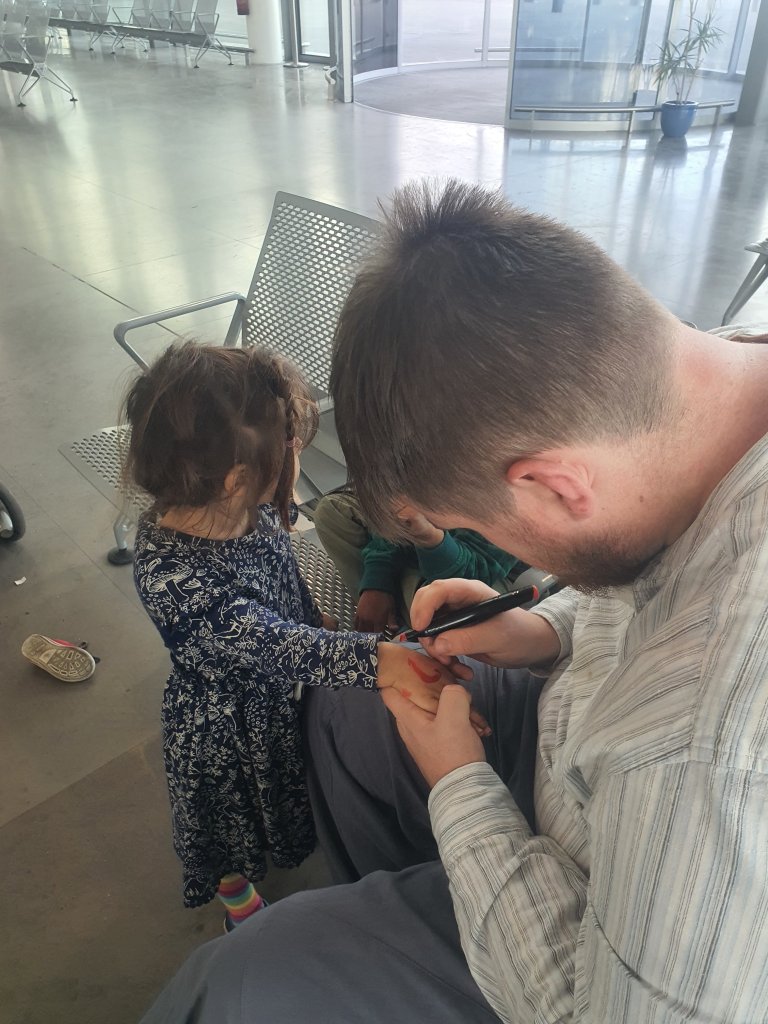
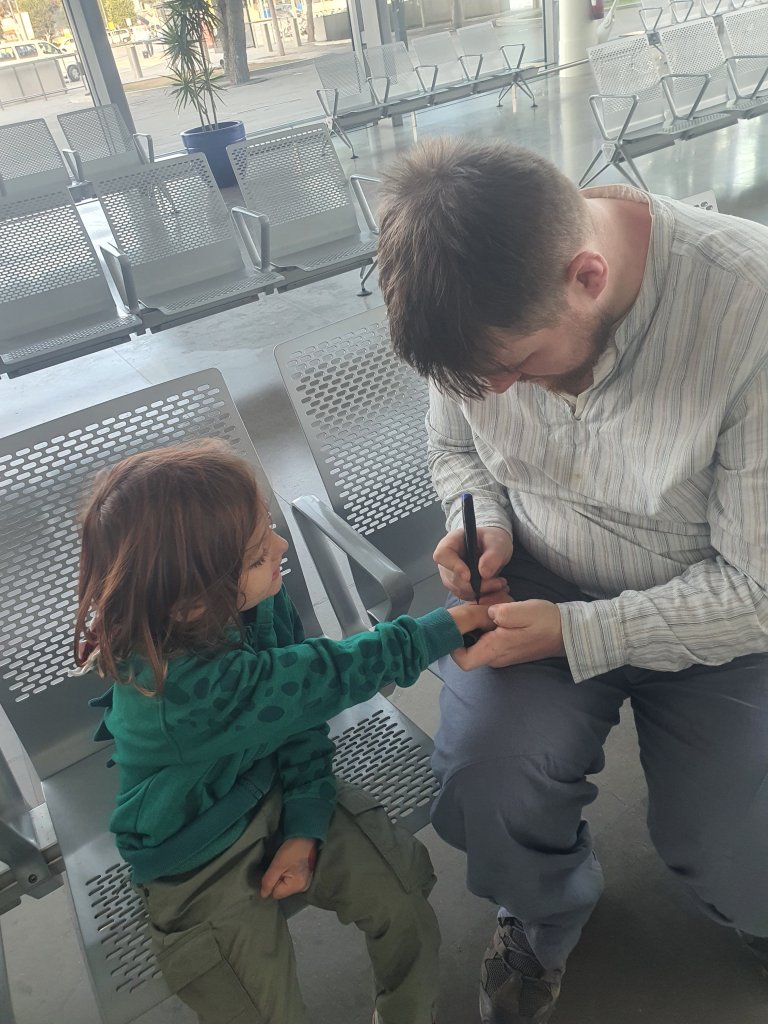
We gave the kids, love buttons.

Yep, they are as cute as they sound, and totally harmless.

Drawing a heart on each of their hands, one colour for mummy, one colour for daddy; the kids have had a slowly fading inked heart of their hands, which they’ve been able to look at and press, and feel a sense of connection, of love, of wantedness with their dad.

Of course they know they are loved. Every voice message, video call, and hug tells them that.

And yet, there is something powerful in the symbolism of a drawn signature; theirs and theirs alone… to share and compare between brothers and sister, and to remind each other, that they are all loved. They can see it. They can feel it. They, in their childhood wisdom, are able to live in it.

Being away from a parent, regardless of how adaptable a child is, is tough. We ask for a lot of their courage, understanding, acceptance; and often, though the narrative is changing, don’t really sit and think about life from their point of view.

For example; to my kids right now, I’d imagine a collective narrative like this one:

Mummy has moved us all (except daddy) away from our home, into someone else’s (albeit a trusted and loved grandparents home), away from friends, away from toys and parks and spaces we know.
We’ve played and done things, and miss home.
We miss dad.
We miss our toys and television, and our special pillows.
We miss our stained red sofa and the stairs we play slide on.
We also like the parks here, and some of the people we’ve met.
We like having grandparents around, but we also miss our dad.
We see other dads, and wonder why ours can’t be here.
We wonder why money and jobs and houses are so important to the grown ups.
We feel happy and sad and a mix of other things we aren’t sure we have names for… but every day we play and try our best, and we’re with mummy, so we’ll be okay.

Looking at life from their view helps realign my own. It’s how and why I chose to create these love buttons; because simply saying I love you, didn’t feel like enough.

Overthinking Play

Play is a vital part of childhood. We develop most of our early skills through play and so allowing my son a variety of ways to play is currently a top priority.

This one is simple really, I just wanted to share about the way we play. Having a 2 year old means a LOT of testing, and sometimes it’s not always possible to spend every single minute involved in their play.

There is housework, cooking, showering, going to the loo etc etc etc. Some things, there is room for my toddler, even if I don’t necessarily want to share; for example, I have given up attempting to have a wee without either being followed or demanded down the stairs again. However, when I am cooking or washing the dishes, the boundaries are firmer, he is NOT allowed to put his hand in the hot water, or play with the oven dials or use a knife. Simple right ? Unless you are a 2 year old who feels like the world is overwhelming and unfair and Mummy never lets you do anything interesting!

It’s hard being a toddler. And I say that sincerely.

Honestly I would love to stay on the floor or sofa and play all day. Some days we do that, and have left-overs or daddy makes dinner. But other days it’s impossible. Instead of ‘dealing with a screaming toddler’ though, I try to find ways we can adapt situations so he is busy while I am too. It doesn’t always work, but even 50% is better than nothing. Extra bonus, it gives me something to explore with him another day or ask about before bed.

These are some of my recent play set ups. I haven’t used them all yet, and will fully confess that a lot is inspired by various Instagram accounts who are much better at this than I am. Regardless, what we are doing works for us right now so that’s all that matters to me.

Play is hard sometimes. I tend to expect something from it or for TP to want new things, but often he’s happy to repeat crafts we’ve done. Letting go of expectations is something both H and I are working hard on. Child led can be challenging. The results are worth it, in time.

How do you play? Are there any prompts you’d like to see or try? Send me your thoughts and ideas, I’d love to hear.