
With the current state of the world and the International Court of Justice hearings the past couple of days, I’ve been thinking a lot about the way I want to involve my kids in politics; given that my educational background lies in the subject. I’m writing this after my son asked what I was listening to and so, I shared, in as much detail with age appropriate resources as I could.
Political discussions with our kids is controversial issue between my husband and I, because though we agree we don’t want to shelter them entirely, we also know that our children, (especially oldest) is highly sensitive, and striking a balance is hard. He actively worries about death, and takes a lot to heart; so not oversharing or making things too gruesome is a priority.
So what can we do? I think about these things: Share about what’s going on or hide it? Is there a line where its’s too much? Where is the line? What happens if we cross it? How much is sharing political views and how much is imposing our views rather than entering into discussion?
Keep in mind, my oldest child is not yet 7, so a lengthy debate with sources and citations is probably a few years away; but does that mean I shy away from it entirely? No.
Instead, I’m choosing to talk politics in a way that works for our family.
This means, I’m sharing the ongoing bombardment of Palestine and elements of the history including Oct 7th, through play.
PLAY is the way our children process things, so to me, it makes sense that we should talk about politics through play.
We talk about bodily autonomy, we’ve spoken about birth-rights, we’ve spoken about the climate crisis, all through play before; this approach works well for us.
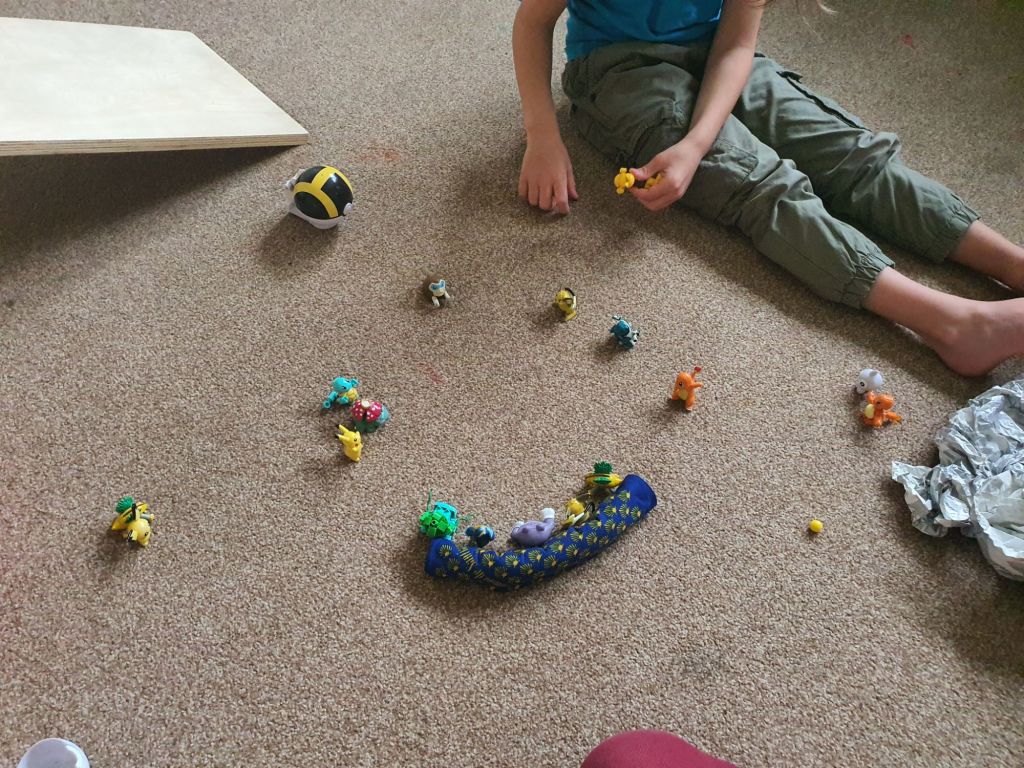
Today, as my son asked about the ICJ and what was going on (he couldn’t hear it due to my earphones), and we were just about to go back to playing Pokémon, I decided that the best way to explain it was using the Pokémon toys and creating a battle scene, where some were fighting, others were supporting and then there was a court of judges (also Pokémon) who were being asked to listen to and pass a judgement on the battle.
In using the toys, the intensity of what is going on was transferred to the toys; which made it accessible for my son, but also gave me the mental space I needed to play rather than assume we can talk about the dynamics of the situation. In doing this, time and time again I am shown that not only is play a brilliant method of communication, I am also able to hold space, work through questions – such as “why doesn’t Squirtle’s team do it like this?” or “why can’t all the Caterpie’s hide safely?” in a way that gives us so much scope for coming up with creative solutions and brings in elements of problem solving and conflict management that, in today’s play, gave my son the chance to work it out between the Pokémon, so that when they did all figure things out, the outcome worked best for everyone.
I understand this is utopian; but it works for us right now. As they get older, we may add in harsher elements that give more room for understanding the scopes of reality, but that is something that will come through play too, as they process, ask questions and develop responses where they understand that there isn’t always a clear winner or loser in life. We did this with Star Wards characters a few weeks ago, and my daughter, though younger found much more joy in the stories, branching off in her own spins to talk about how some win, some lose, and some have to say sorry, help fix buildings and some get lost in space – demonstrating that it isn’t always an age or stage, but the tolerance a child may have to cope with events of horror.
For my daughter, story telling and drawing is one of her chosen mediums of working things out. It is her play. For my son, it’s imaginary play, with characters we act out or toys we hold. Both are valid. Both have room to explore complex human emotions and situations. And importantly, both give me as the adult, room for impartiality, room to contradict, and room to support; in a way that a political debate with real life events probably would not do so graciously.
If you are debating talking to your kids about politics; in any scope, I implore you to consider this approach. If you are totally against it but not sure why, I’d say this allows you to be distant enough that it doesn’t have to resemble anything, but gives you a chance to test waters. If you are already speaking to your kids about politics, I’d love to hear how those discussions go (if you’d be up for sharing of course!).
With love,
Rohana x
 Supporting you from pregnancy to parenting